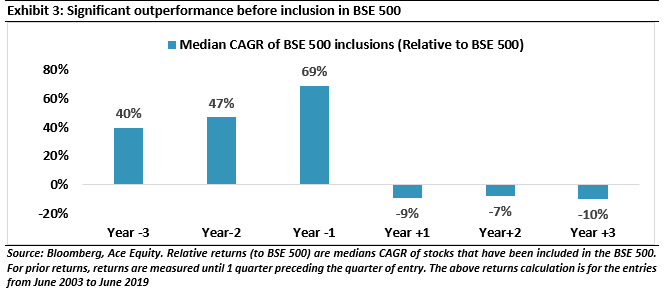
Given that each year 60 companies enter the BSE500, we can see that there are certain economic drivers which are helping well run small firms explode into prominence. From an investors’ viewpoint, in the three years run-up to entering the BSE500, new entrants outperform the index at a CAGR of as much as 40%, indicating significant return opportunity before these stocks are discovered by institutional investors. However, at the same time, high promoter-dependency, smaller size and relatively shorter operating history necessitate much higher degree of research rigour, diligence and investment horizon/patience from the investors. At Marcellus, the key objective of our small cap fund “Little Champs” is to own a portfolio of about 15 sector leading franchises with stellar track record of capital allocation, clean accounts and high growth potential. While we intend to fill our portfolio with winners, we want to be particularly sure of staying away from dubious names.
The case for small-cap investing
More and more Small caps gaining prominence and an entry in BSE500
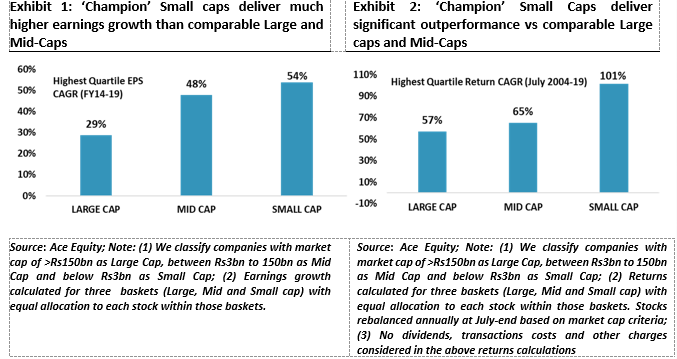
The best performing stocks on earnings growth as well as stocks price returns in the recent years have been names relatively unknown a decade back. For instance, of the 10% best performing stocks over FY09-19, ~80% are stocks which ranked below 500th on market capitalisation as at March 2009-end. This is also evident in the significant churn in BSE500 (on an average BSE500 churned almost 12% p.a. over the last ten years) as these high performing small caps replace the incumbent laggards. Given that each year ~60 new names are entering the BSE500, such a trend clearly points to underlying economic drivers which are helping well run small firms explode into prominence.
The three common stories across these successful firms which have grown from near obscurity to prominence over the last decade have been:
Disproportionate benefits in owning these companies before their ‘discovery’
From an investors’ viewpoint, more relevant than the churn in BSE500 is the returns that these entrants into the BSE500 produce as they fly into the index. As shown in the chart above, in the three years run-up to entering the BSE500, entrants outperform the index at a CAGR of as much as 40%!!!
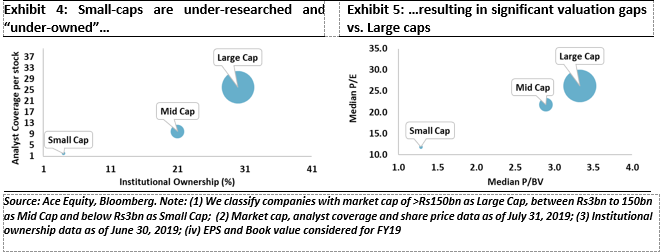
This return performance is not only a function of the superior earnings growth delivered by these firms in the run-up, but also a result of their valuations getting re-rerated. When these stocks are small and still inventing the wheels of their business, they are largely unnoticed by the large investors’ and research analysts’ communities. This results in them trading at significant discounts to their larger counterparts. However, once they reach a particular size (say market capitalization above US$0.5 billion), they come under the ambit of more and more research analysts’ coverage and institutional investors’ ownership and thus move up the valuation band.
But beware of the pitfalls
It goes without saying that not every small firm will be successful and the winners will be those who have: (a) the work ethic to grow the organisation larger such as instilling process oriented culture, devolution of power & responsibilities to build scale etc; (b) the capital allocation skills to rationally and patiently invest in building long term competitive advantages; and (c) the skill and the drive to run efficient manufacturing operations such as keeping the working capital cycles tight.
There is only a narrow set of small cap companies that have been able to pass these tests and eventually generate significant shareholders’ wealth. On the other hand, there are more examples of small cap stocks that not only failed but also ended up destroying significant investor wealth. Hence, while the reward is enormous for picking the right small cap stocks, the associated risks and rigour required are manifold compared to that in the large cap and even mid cap space for that matter.
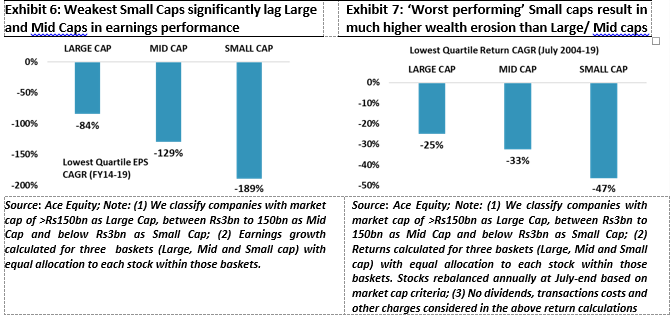
In particular, the risks/hardships of investing in a small cap are due to the following factors:
Marcellus Little Champs PMS – how do we intend to navigate the world of small caps?
At Marcellus, the key objective for the “Little Champs” fund is to own a portfolio of about 15 sector leading franchises with a stellar track record of capital allocation, clean accounts and corporate governance and at the same time high growth potential. While we intend to fill our portfolio with winners, we want to be particularly sure of staying away from dubious names where we are not convinced about the cleanliness of the accounts or the integrity of the promoters (even though business potential may sound promising) as fruits of company’s performance may not get shared with minority shareholders. We intend to keep the portfolio churn low (not more than 25-30%) to reap the benefits of compounding as well as minimise the impact of trading costs.
We use the following process to build the Little Champs portfolio:
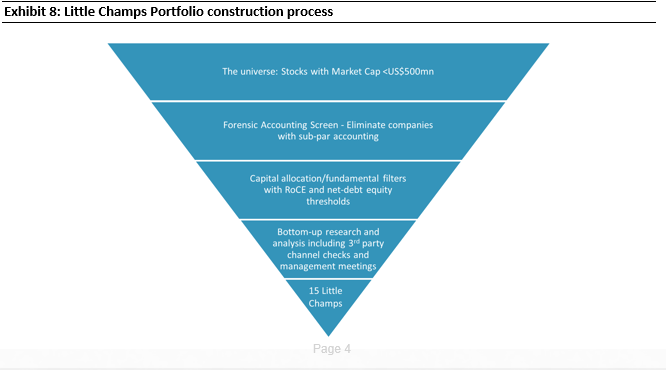
We have developed the following rigorous screening frameworks to help shorten the large universe of ~1,200 small cap companies into a researchable universe of 40-50 companies
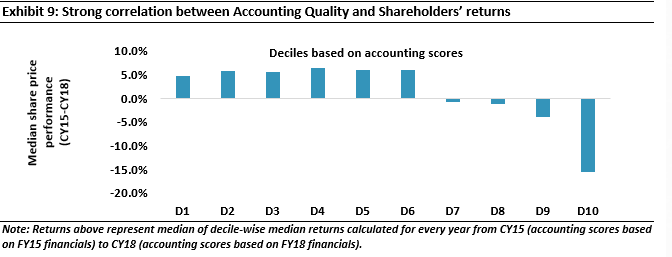
a. Our forensic accounting framework draws upon Howard Schilt’s legendary text on forensic accounting, “Financial Shenanigans”. Using a set of forensic ratios, we rank the companies on accounting quality. This helps us stay away from companies with dubious financials. Our experience and analysis have shown that shareholders’ returns are strongly linked to accounting quality.
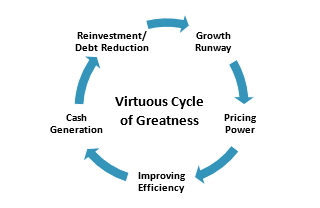
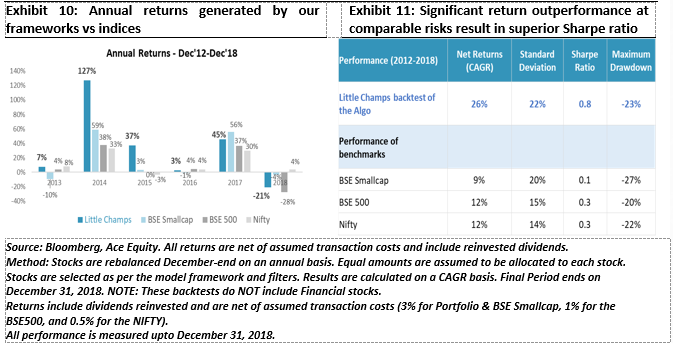
We have backtested the above frameworks for several years and the results have shown that the portfolio generated by the Algo has not only expectedly outperformed the BSE Sensex (the benchmark) during periods of market downturn but also generally outperformed or matched the benchmark performance during market upturns. Given, the rule of compounding, if you fall less and rise equally, you reach higher – the framework has generated significant outperformance over December 2012-December 2018.
The stocks shortlisted by our screening frameworks are taken up for deep dive research and diligence. Besides analysis of the published financials and other secondary data, we aim to build insights into the companies through interacting with a host of primary data network sources. Here, we draw upon our following strengths:
In this stage we bring down the 40-50 names shortlisted by our frameworks to around 15-20 names that we end up investing in.
The portfolio names will be subject to continuous monitoring (keeping a tab on results, continuing to meet customers, competitors and suppliers of these companies whilst maintaining regular contact with management) of major developments. We do not intend to put much weightage to short-term impacts like weak quarterly earnings owning to macro/business cycles. However, we would not desist from reacting in case of any structural changes in the company like key management changes (where we think the new management is not of the same pedigree as the earlier one), any capital allocation decisions that seems out of order or any corporate governance steps that does not seem to be in the best interests of the minority shareholders.
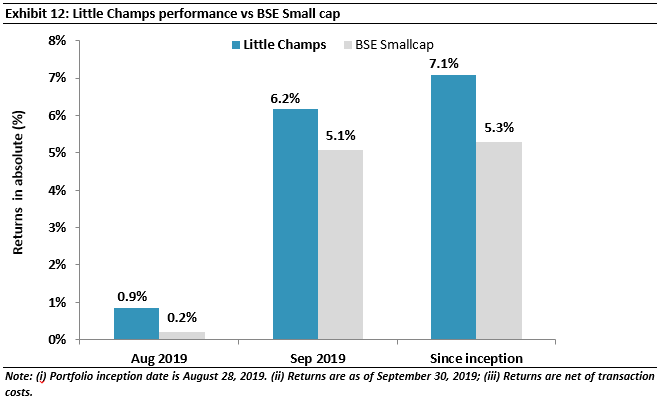
Performance update of the Live Fund
Our fund went live on August 28, 2019. The performance so far is shown in the below table.
Regards
Team Marcellus
If you want to read our other published material, please visit https://marcellus.in/blog/
Note: the above material is neither investment research, nor investment advice. Marcellus does not seek payment for or business from this email in any shape or form. Marcellus Investment Managers is regulated by the Securities and Exchange Board of India as a provider of Portfolio Management Services and as an Investment Advisor.