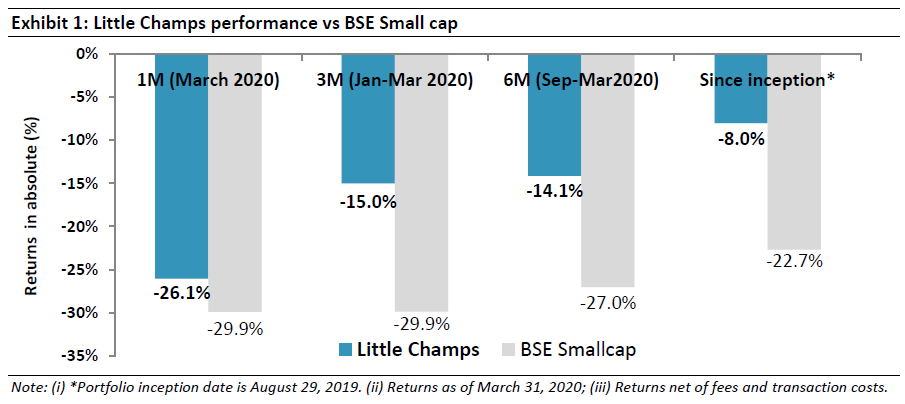
We see limited impact of COVID-19 on Little Champs’ fundamentals beyond the short-term business disruptions given: (i) their strong balance sheets will help them navigate the near-term stress much better than leveraged peers; and (ii) export oriented portfolio companies’ exposure is mostly in essential products (pharma, agro, food) or replacement markets rendering immunity from a potential global recession. In fact, Little Champs are likely to emerge relatively stronger out of the situation as they can afford to invest in business growth (product/process innovation, market expansion) through the crisis but most of their peers cannot. Hence, we expect the Little Champs portfolio to demonstrate resilience in the market downturn (portfolio down 15% since January 2020 vs BSE Smallcap’s 30%) as well as to recover faster as the uncertainty fades.
Performance update of the live Little Champs Portfolio
At Marcellus, the key objective of the “Little Champs” Portfolio is to own a portfolio of about 15 sector leading franchises with a stellar track record of capital allocation, clean accounts & corporate governance and at the same time high growth potential. While we intend to fill our portfolio with winners, we want to be sure of staying away from dubious names where we are not convinced about the cleanliness of accounts or the integrity of the promoters (even though business potential may sound promising) as the fruits of company’s performance may not get shared with minority shareholders. We intend to keep the portfolio churn low (not more than 25-30% per annum) to reap the benefits of compounding as well as minimize trading costs.
The Little Champs Portfolio went live on August 29, 2019. The performance so far is shown in the below table.
COVID-19: Where do we stand?
In our March 2020 Little Champs newsletter, we had discussed that we see limited long term impacts of COVID-19 on our Little Champs portfolio. Since the time we wrote that newsletter, there has been a mix of positive and negative developments concerning the disease:
Hence, over the last one month, the concerns related to Covid-19 with respect to Indian companies has shifted from being a supply-side issue (disruption in imports from China) to a demand side issue (domestic lockdown and disruption in Europe/USA- the biggest export markets for Indian companies).
Impact on the Little Champs portfolio
In our 23rd March, 2020 webinar, we had discussed our thoughts on how we see the impact of Covid-19 on Marcellus’ portfolios including Little Champs. We reproduce those thoughts below:
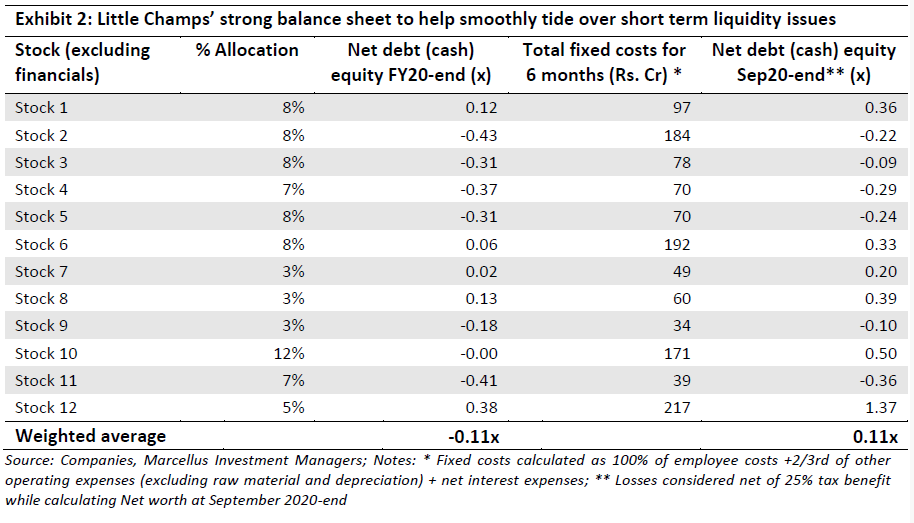
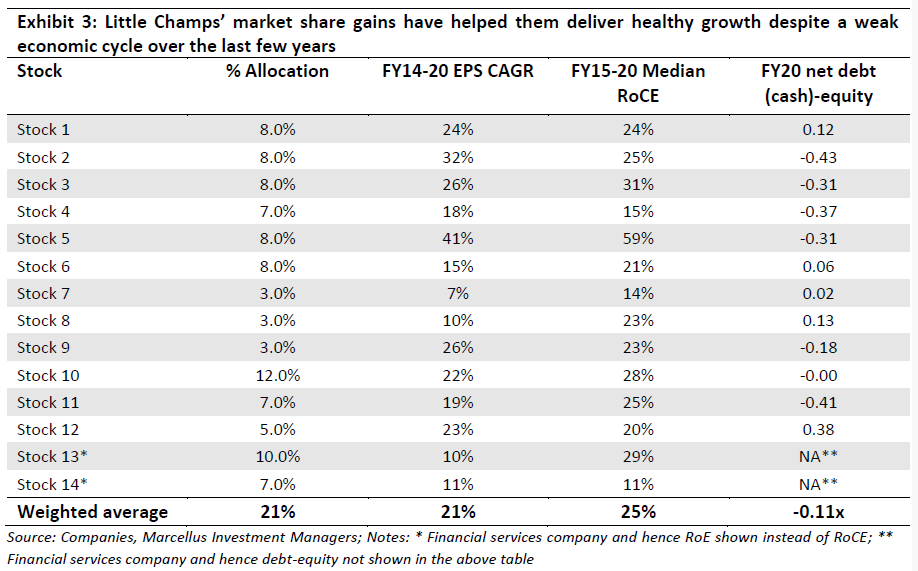
We don’t see any reason why the last 5 years’ story can’t play out in the current situation; in fact logic suggests an acceleration in market share by Little Champs going forward. The strong balance sheets of the Little Champs enable them to not only survive the short-term stress but also to continue to invest for future growth unlike their cash starved smaller peers for whom survival will be the key focus over the next few months.
We believe that financials stock in our portfolio (one bank and one NBFC) are best positioned to consolidate lending market share over the next 3-4 years because of a combination of: a) a strong liabilities franchise with favorable Assets Liabilities Management (ALM) profile; b) comfortable capital adequacy ratios; c) superior quality of loan book compared to their competitors; and d) superior collections capabilities vs peers. Hence, any short-term moderation in earnings growth trajectory of these firms is likely to be more than offset by acceleration in earnings growth through market share gains over the next 3 years.

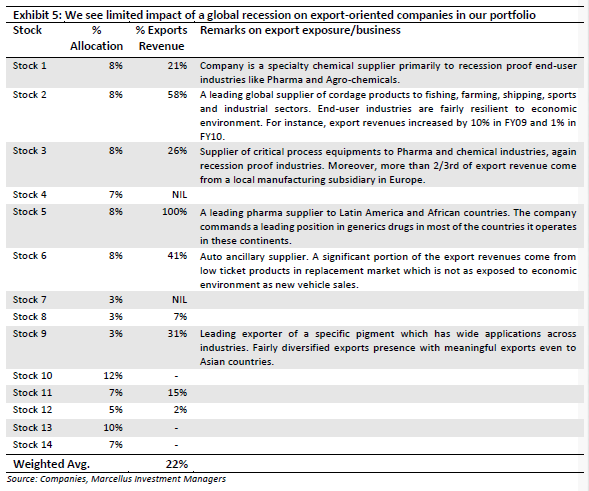
With Europe and USA, the key destinations for Indian exporters (also for the Little Champs portfolio companies with exports exposure) witnessing a lockdown and a possibility of near-term recession, there are genuine concerns surrounding the companies with export exposure. In our Little Champs portfolio, there are six stocks where revenues from exports exceed >20% of total revenues (weighted average export revenue share for the portfolio is close to 22%). However, we see limited impacts due to the reasons mentioned in the below exhibit.
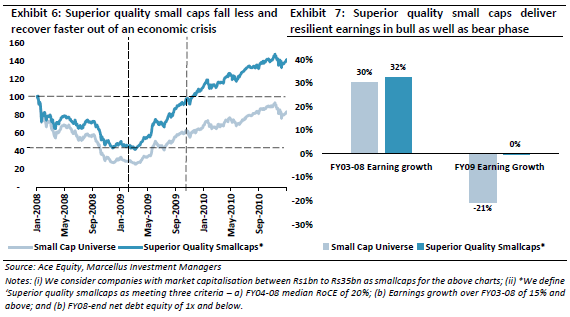
Lessons from the past: Superior quality smallcaps recover faster than the broader smallcaps universe
After a 14-month long fall in the stock market during the 2008 global financial crisis, the market bottomed out on 9th March 2009. As shown in the exhibit below superior quality small-caps (We define ‘Superior quality smallcaps as meeting three criteria – a) FY04-08 median RoCE of 20%; (b) Earnings growth over FY03-08 of 15% and above; and (b) FY08-end net debt equity of 1x and below) recovered back to its pre-crash levels by November 2009 i.e. within 8 months of the market bottoming out in March 2009. This is mainly on account of all the factors explained above on how strong franchises are able to consolidate their position in a downturn, emerge stronger and hence gain disproportionate benefits of a market recovery.
On the other hand, weaker smaller peers get structurally damaged during a slowdown as most of them face existential issues. Similarly, in a market slowdown, a whole host of smallcaps with questionable corporate governance go down the drain. This is suitably demonstrated in the below chart where the broader small-caps universe had not even managed to reach the pre-crisis level by November 2010 (i.e. nearly 20 months from the market bottoming out). Not surprisingly, the BSE SmallCap Index recovered to its January 2008 level in February 2017 i.e. after nearly 9 long years.