White Collar Jobs Growth & Wage Growth: Twin Drivers of India’s Slowdown
From Diwali 2023 onwards, Indian companies’ earnings growth has decelerated at a rapid rate. Underpinning this deceleration is a sharp conk-off in consumption growth, long the mainstay of the Indian economy. Key drivers of this consumption downturn are a sharp deceleration in white collar job creation alongside a reduction in real wages for white collar workers over the past eight years. Both of these are side-effects of the rise of AI & automation in India’s factories and offices.
Saurabh Mukherjea
Founder & CIO
What is driving the earnings slowdown in India?
Corporate earnings have experienced a rapid deceleration since Diwali 2023, fundamentally driven by a sharp decline in consumption growth, which constitutes 60% of the GDP. This downturn follows a period where households, after saving during Covid-19, engaged in “revenge spending” from Diwali 2021 to Diwali 2023, depleting their savings to a near 50-year low by Holi 2024. The core reasons for this consumption slump are a significant slowdown in white-collar job creation and a reduction in real wages for these workers over the past eight years, both stemming from cyclical factors like reduction in workforce that was zealously hired during covid and structural factors like the rise of AI and automation. White-collar job openings, crucial for supporting 200 million other jobs, plummeted from 11% per annum before FY20 to just 3% afterwards, leading to per capita job stagnation. This is due to both a cyclical unwinding of post-Covid hiring and a structural trend of AI replacing human roles, with companies like TCS and HCL Tech leveraging AI to reduce workforces. Crucially, average incomes in Nifty 50 companies have NOT kept pace with the cost of living (CPI inflation) since FY16, indicating a real decline in purchasing power for professionals.
A gateway to investing in some of the best global companies from the Developed World.
Portfolio Outlook
The portfolio delivered a decent return this month, though we trailed the benchmark a little. That is not unusual in periods when markets are being pulled higher by a narrow set of mega-cap stocks. Our approach has been consistent: we are highly conscious of valuations and have deliberately avoided chasing the most hyped names. Many of these companies are fantastic businesses, but the price being asked of investors today leaves very little margin for error. We would rather protect capital and stay invested in compounders that combine quality with reasonable entry points than depend on stretched multiples holding up. This discipline means that at times we will lag in frothy markets, but it also gives us confidence that when sentiment cools, we are less exposed to sharp drawdowns. In our view, patience on valuation is one of the most reliable ways to preserve and grow wealth over the long run.
What worked and what didn’t?
Aerospace names such as Heico and TransDigm stood out with strong earnings and steady aftermarket demand, while data franchises like S&P Global reinforced the value of recurring revenues in volatile markets.
Our large technology holdings, including Microsoft, Amazon, and Alphabet, contributed positively but not to the same extent as the handful of AI leaders that drove benchmarks higher.
On the weaker side, Old Dominion reflected continued softness in freight, and defensives such as Waste Connections offered stability but lagged in a risk-on environment.
Performance of the scheme
Rakshit Ranjan Founder & Portfolio Manager
Consistent Compounders Portfolio
Concentrated portfolio of heavily moated companies that can drive healthy earnings growth
Portfolio Outlook
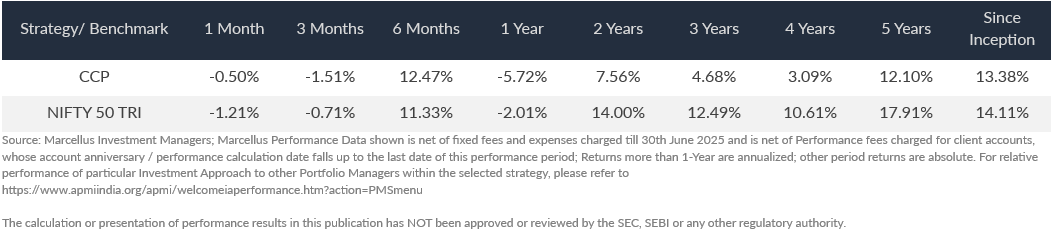
From a macro-perspective, we see incremental tailwinds to our portfolio companies from the recently announced GST rate changes (high exposure to B2C consumption-oriented businesses) and risks of incremental headwinds for IT services (small exposure in CCP). We expect healthcare services to see a structural rise in penetration over the next 10-15 years, and hence benefit businesses such as hospitals, diagnostics and insurance. Our recent position sizing changes reflect expected acceleration in EPS growth of companies such as Asian Paints and Astral and moderation in growth of lenders in our portfolio. Key risks to some of these changes: weakness in consumption and household incomes. Overall, we expect quality as a style factor to do well over the next few years, as few companies use their strengths to tide over an otherwise moderate growth in the broader economy. Key risk to these expectations remains a significant drawdown in the broader market due to elevated valuations and weak earnings growth of the benchmark indices. CCP’s approach towards portfolio concentration and absolute return orientation is well suited to such an environment.
What worked and what didn’t?
Over the last 12 months, top 3 detractors in CCP have been Tube, Trent and Asian Paints. We have increased allocations in two of these stocks recently – an attempt to benefit from peak pessimism in consensus expectations. The top 3 contributors to the portfolio over the last 12 months have been Narayana, Divis and Eicher. We have trimmed exposures in these recently to benefit from rebalancing opportunities elsewhere in the portfolio. Recently changes to list of stocks in the portfolio – Info Edge and Vijaya Diagnostics have replaced Titan and Alkem. CCP remains a low churn portfolio.
Performance of the scheme
Tej Shah Portfolio Manager
Marcellus Curation Portfolio
Flexi-cap portfolio focused on investing in quality, well-managed Indian companies positioned to deliver healthy long-term growth
Portfolio Outlook
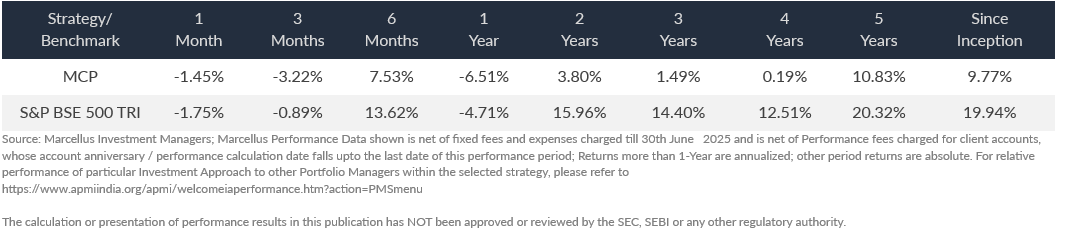
Despite a year long time correction for the broader markets, we believe Indian mid and small cap stocks continue to be expensive. While our approach continues to be bottom-up, we have reflected our view on stretched mid and small cap valuations by allocating nearly two-thirds of the portfolio to large cap names. We have a positive outlook on healthcare, private sector financials and select industrial names – we believe our investee companies in these sectors are well positioned to deliver market share gains and profitable growth. We expect fundamentals and growth prospects for our investee companies in the financial services and consumption sector to improve in the second half of the year as the effect of GST cuts, CRR cuts and income tax rate reduction starts to become visible. The risk to our thesis in healthcare and financials could be adverse regulation which can curb supernormal profitability of well run players. On the other hand, we have consciously avoided exposure to energy, utilities, and real estate, given the difficulty in identifying businesses within these sectors that can consistently generate healthy RoCEs. While valuations across the market remain elevated, the moderation seen over the past year is a healthy development. We view this as creating an attractive setup for quality companies
What worked and what didn’t?
Over the past 12 months, the top 3 detractors for the portfolio have been Ahluwalia, Tube and HCL Tech. The top 3 contributors to performance have been Narayana, Eicher and Divis Labs. In general, our exposure to healthcare, IT and financials have worked well over the past year while our exposure to industrials (Tube, Ahluwalia) and building material names such as Asian Paints and Astral have proven to be a drag.
Performance of the scheme
Tej Shah Portfolio Manager
Keshav Binani Co-Portfolio Manager
Kings of Capital
Our financial sector focused investment strategy with a portfolio banks, NBFCs, life and general insurers, asset managers and brokers
Portfolio Outlook
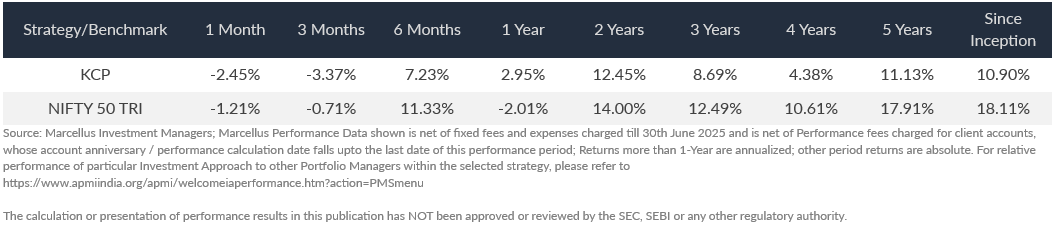
Marcellus’ KCP portfolio’s EPS growth has been consistently higher than that of the index (11% YoY EPS growth in 1QFY26 vs. 5% for Nifty50). We believe with the time correction of the past year, the market is more rational and aware of risks versus a year ago. This is also the case because of visible asset quality issues across segments such as MFI, credit cards, MSME and unsecured retail loans. Our focus on quality and stock selection has proven to be a differentiator in such an environment. Most of the KCP lenders are seeing better asset quality outcomes versus peers in their respective segments. Unlike the more benign environment of 2021-24, we believe our conservative, countercyclical approach will be a differentiator. Our earlier decision to raise cash in the portfolio has proven prudent, as consensus estimates have been revised down for many of our holdings in the last 3 months.
What worked and what didn’t?
Over the last 12 months, top 3 detractors in KCP were CMS Info Systems, Info Edge and ICICI Lombard. The top 3 contributors to the portfolio over the last 12 months have been HDFC Bank, Prudent Corporate and Kotak Bank. We have trimmed exposure in Prudent to benefit from rebalancing opportunities elsewhere in the portfolio. In line with our defensive stance, we have increased allocations to defensive sectors such as ratings and life insurance, selectively we have added exposure to microfinance to play the cyclical recovery.
Performance of the scheme
Ashvin Shetty Portfolio Manager
Little Champs & Rising Giants
SMID-cap strategies that invests in companies with good corporate governance, capital allocation track record and strong sustainable competitive advantages
Portfolio Outlook
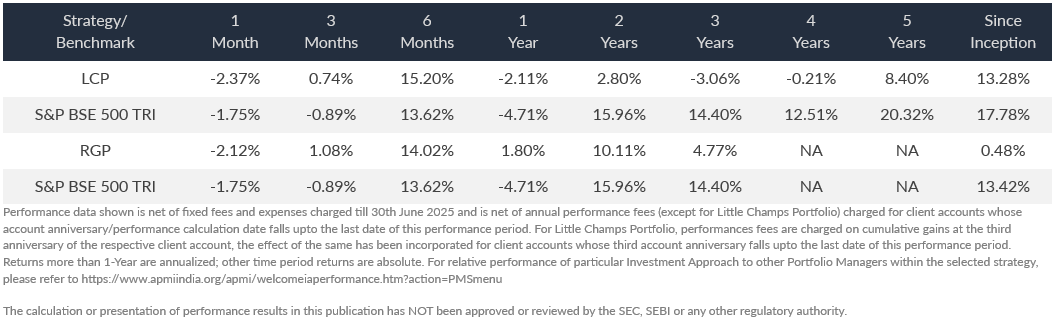
With the additional tariffs coming into force, we see disruptions to the export-oriented companies. We continue to make appropriate adjustments to the LCP/RGP portfolios to deal with this uncertainty. We remain cautious about both the fundamentals as well as the valuations in the broader SMID-cap space making us: (i) allocate more/primarily towards stocks with earnings visibility/valuation comfort; and (ii) increase the cash position in both the portfolios – a tactical move to both mitigate the impact of likely drawdowns as well as provide us the dry powder to get into new stocks or increase the allocation to existing portfolio stocks in case, we see corrections not in sync with the that warranted by the fundamental performance
What worked and what didn’t?
Both LCP and RGP portfolios demonstrated resilient earnings performance in 1QFY26 with median earnings growth of 13% – marking a sustained double-digit earnings growth since 2QFY25. Having said that the recent imposition of elevated tariffs by USA on the Indian exports does have impact on some portfolio stocks (Ultramarine, LT Foods, Garware Technical, Tarsons, and Carysil) – which can reflect in the Q2 results of these companies (we have seen some drawdown in the share prices of these companies in the recent months). However, we believe the impact will be somewhat limited due to (i) non-significant exposure to USA; (ii) lack of substitutes for products supplied by these companies; or (iii) companies with significant exposure accounting for limited position in the portfolios.
Performance of the scheme
The above material is neither investment research, nor investment advice. Marcellus Investment Managers Private Limited (“Marcellus”) is regulated by the International Financial Service Centre Authority (Fund Management) Regulations, 2025 (earlier 2022) (“IFSCA”) as Fund Management Entity – Non retail and is also regulated by the Securities and Exchange Board of India (“SEBI”) rendering Portfolio Management Services. Marcellus is also registered with US Securities and Exchange Commission (“US SEC”) as an Investment Advisor. No content of this publication including the performance related information is verified by SEBI, IFSCA or US SEC. If any recipient or reader of this material is based outside India or US, please note that Marcellus may not be regulated in such jurisdiction and this material is not a solicitation to use Marcellus’s services. This communication is confidential and privileged and is directed to and for the use of the addressee only. The recipient, if not the addressee, should not use this material if erroneously received, and access and use of this material in any manner by anyone. Global Compounders Portfolio (GCP) is a strategy offered by GIFT City branch of Marcellus Investment Managers Private Limited and the other strategies are offered by Marcellus Investment Managers Private Limited. This material may contain confidential or proprietary information and user shall take prior written consent from Marcellus before any reproduction in any form. Data/information used in the preparation of this material is dated and may or may not be relevant any time after the issuance of this material. Marcellus takes no responsibility of updating any data/information in this material from time to time. The recipient of this material is solely responsible for any action taken based on this material. The recipient of this material is urged to read the Disclosure Document/Form ADV, Form CRS and any other documents or disclosures provided to them by Marcellus, as applicable, and is advised to consult their own legal and tax consultants/advisors before making any investment in the portfolio. All recipients of this material must before dealing and or transacting in any of the products referred to in this material must make their own investigation, seek appropriate professional advice and carefully read the Disclosure Document, Form ADV, Form CRS and any other documents or disclosures provided to them by Marcellus, as applicable. Actual results may differ materially from those suggested in this note due to risk or uncertainties associated with our expectations with respect to, but not limited to, exposure to market risks, general economic and political conditions globally, inflation, etc. There is no assurance or guarantee that the objectives of the investment strategy/approach will be achieved. This material may include “forward looking statements”. All forward-looking statements involve risk and uncertainty. Any forward-looking statements contained in this document speak only as of the date on which they are made. Further, past performance is not indicative of future results. Marcellus and any of its directors, officers, employees and any other persons associated with this shall not be liable for any loss, damage of any nature, including but not limited to direct, indirect, punitive, special, exemplary, consequential, as also any loss of profit in any way arising from the use of this material in any manner whatsoever and shall not be liable for updating the document. The stocks described about in the presentation do form the part of our Marcellus’ portfolio so we as Marcellus, our clients, our employees and their immediate relatives do have interest and stakes in the described stocks. The described stocks are for illustration purpose only and not recommendatory. This material may contain confidential or proprietary information and user shall take prior written consent from Marcellus before any reproduction in any form