How Four Mega-Reforms by the Indian Government and the RBI Dismantled the Barriers to International Capital.
RBI data reveals a staggering 58% surge in capital outflows from India over the past 5 years. This shift underscores a critical imperative: the necessity of investing in dollar-denominated assets. This is particularly vital given that the INR has historically depreciated by approximately 40% against the USD every decade.
Saurabh Mukherjea
Founder & CIO
This makes global diversification no longer a luxury but a necessity for Indians for two major reasons:
To fund future dollar-denominated expenses and
To safeguard purchasing power against a structurally weakening currency.
While high friction costs once made international markets inaccessible, four “blockbuster” reforms have recently dismantled these barriers, ensuring that global investing is now as tax-efficient as domestic alternatives.
Here are the four shifts unlocking the world for Indian investors:
The Rise of GIFT City: A world-class financial jurisdiction that allows us to manage 100% global portfolios in a structure that is now both cost and tax-efficient.
Tax Parity (LTCG Slashed to 12.5%): The reduction of Long-Term Capital Gains Tax on global stocks from 20% to 12.5% aligns them with domestic equities, removing the “tax penalty” on global compounding.
Easier LRS Norms: Investors can now hold foreign currency accounts in GIFT City to invest or spend without repetitive forex fees or heavy compliance burdens.
Corporate Global Access: Indian companies can now invest up to 50% of their net worth in foreign financial assets without prior RBI approval.
These reforms bridge the gap between Indian savings and the world’s best franchises. Understanding these regulatory tailwinds also help you build wealth that is truly resilient.
Read Saurabh’s latest blog post here for a deeper dive into these reforms.
Tej Shah
Portfolio Manager
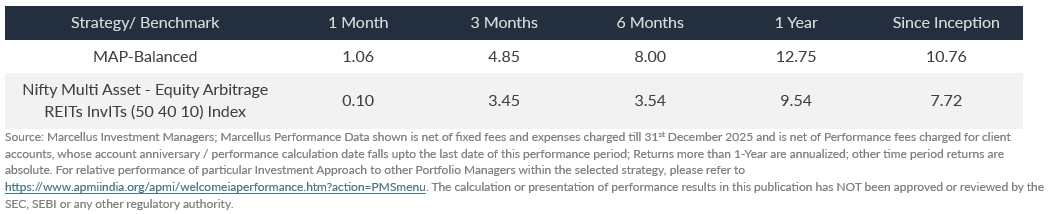
Multi Asset Portfolio
Rules based portfolio with a basket of different asset classes built on your financial goals providing risk-adjusted returns.
Portfolio Outlook
We continue to keep a defensive posture with overweight in cash (through arbitrage funds) and underweight in Indian small cap equity allocation. Our tactical allocation framework suggests slight increase in Indian large cap equity allocation and slight decrease in global equity allocation mainly due to elevated US equity valuations.
What worked and what didn’t? Strategy’s diversified positioning across five major asset classes chiefly, global equities, Cash, REITs/INVITs, Gold along with Indian equities, against the backdrop of elevated starting valuations in domestic equities in 2Q 2024 (when we launched the strategy), has served us well. Being tactically underweight domestic equities esp. small caps and overweight cash was a positive as well. As result, the portfolio has outperformed Nifty 50 both over last 12 months and since inception, with lower volatility.
Performance of the scheme (Figures in %)
Omkar Sawant
Portfolio Manager
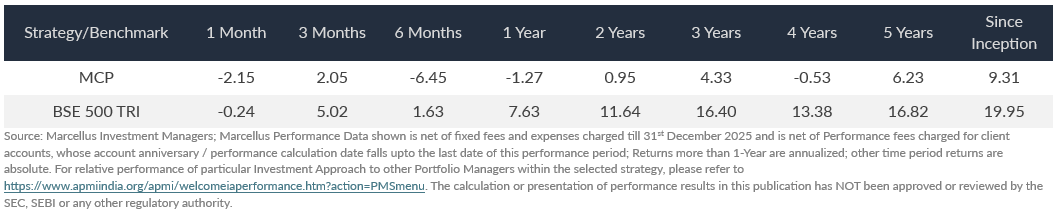
MeritorQ Portfolio
Rules based Multicap strategy investing in relatively undervalued quality companies.
Portfolio Outlook
Post the portfolio rebalancing in December, weighted average free cash flow yield has increased to 2.2% while average return on capital of portfolio stocks remains higher than that of the benchmark. Portfolio remains positioned to weather uncertainty and benefit from possible earnings upgrades, with defensive allocation to large caps and REITs balanced by meaningful allocation in high quality small and midcap companies.
What worked and what didn’t? Increased allocation to large caps has helped over last 12 months. Strategy’s quality bias, still meaningful small cap exposure and underweights in PSUs (esp PSU banks), cyclical sectors like metals and Oil & gas dragged down relative performance over the period.
Performance of the scheme (Figures in %)
Arindam Mandal
Head of Global Equities
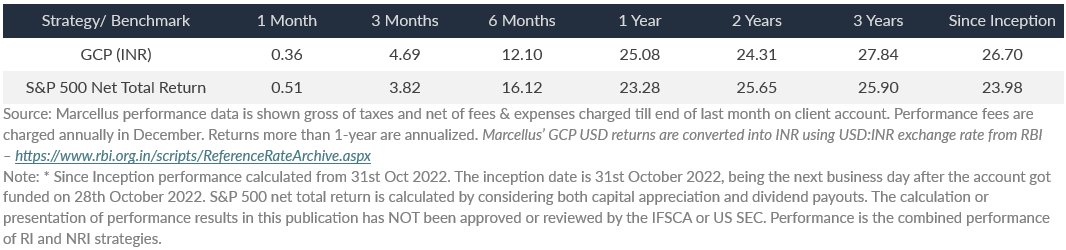
Global Compounders Portfolio
A gateway to investing in some of the best global companies from the Developed World.
Portfolio Outlook
December was flat for the portfolio and broader market following three years of strong performance. Markets consolidated as investors digested gains, though the earnings backdrop and productivity data remain supportive. A ~15% S&P 500 earnings growth forecast for 2026 has bolstered recent valuation re-ratings, while the AI narrative is shifting from capex toward monetization.
We expect market leadership to broaden beyond mega-caps, benefiting our portfolio’s positioning away from high-valuation segments. However, we anticipate higher volatility; credit spreads are near historical lows and geopolitical risks appear underpriced. While the market remains bifurcated, early improvements in cyclicals—including transportation—are encouraging. We remain watchful and disciplined
What worked and what didn’t?
What worked: Select industrial and services holdings benefited from early signs of cyclical stabilisation and steady operational execution.
What did not: Exposure to slower-moving end markets remained range-bound as investors awaited clearer evidence of recovery.
Performance of the scheme (Figures in %)
Rakshit Ranjan
Founder & Portfolio Manager
Consistent Compounders Portfolio
Concentrated portfolio of heavily moated companies that can drive healthy earnings growth.
Portfolio Outlook
Looking ahead, we see two distinct tailwinds for CCP constituents. Firstly, the recently announced GST rate cuts are likely to help the fundamentals of our holdings with high exposure to autos and B2C consumption. Secondly, We remain convinced that healthcare services are in the early innings of a 10-15 year structural rise in penetration. Our portfolio is heavily weighted towards organized players in hospitals, diagnostics, and insurance who are best positioned to capture this shift from unorganized to organized care. We expect “Quality” as a style factor to do well over the next few years. As broader economic growth moderates (from Nifty50’s 24% EPS CAGR over FY21-24 to mid-single digit growth over the last six quarters), the gap between average companies and exceptional ones is likely to widen. In such an environment, companies that rely on their own internal strengths—deep moats and prudent capital allocation—to generate growth will stand apart from those reliant predominantly on external economic tailwinds. We remain vigilant regarding one key risk – given the elevated valuations of the broader indices combined with weak earnings growth, a significant market correction remains a possibility.
What worked and what didn’t?
Marcellus CCP’s current constituents have delivered YoY growth in Revenue / EBITDA / EPS of 15%/19%/12% during 2Q FY26, against Nifty50’s 1%/ 11%/ 7% respectively. The portfolio weighted average ROCE in FY25 was 24%, with a 3-year average reinvestment rate (FY23-25) of 80%. Over the last 12 months, while Narayana, Eicher and Chola have been the biggest contributors to portfolio performance, Trent, Tube and CMS have been the biggest detractors.
Performance of the scheme (Figures in %)
Tej Shah
Portfolio Manager
Marcellus Curation Portfolio
Flexi-cap portfolio focused on investing in quality, well-managed Indian companies positioned to deliver healthy long-term growth.
Portfolio Outlook
Given the year long time correction for the broader markets, we are gradually seeing growth companies being available at more reasonable valuations. While our approach continues to be bottom-up, we have reflected our view on stretched mid and small cap valuations by allocating nearly two-thirds of the portfolio to large cap names. In pockets, we are now seeing stock prices baking in more realistic expectations of the future and we are therefore tilting the portfolio towards more growth names vs being more defensive so far. We have a positive outlook on healthcare, private sector financials and select industrial names – we believe our investee companies in these sectors are well positioned to deliver market share gains and profitable growth. We expect fundamentals and growth prospects for our investee companies in the financial services and consumption sector to improve in the second half of the year as the effect of GST cuts, CRR cuts and income tax rate reduction starts to become visible. The risk to our above thesis could be adverse regulation which can curb supernormal profitability of well-run players. On the other hand, we have consciously avoided exposure to energy, utilities, and real estate, given the difficulty in identifying businesses within these sectors that can consistently generate healthy RoCEs. While valuations across the market remain elevated, the moderation seen over the past year is a healthy development. We view this as creating an attractive setup for quality companies.
What worked and what didn’t? In general, our exposure to healthcare and financials have worked well over the past year while our exposure to industrials (Tube, Ahluwalia) have proven to be a drag.
Performance of the scheme (Figures in %)
Tej Shah
Portfolio Manager
Keshav Binani
Co-Portfolio Manager
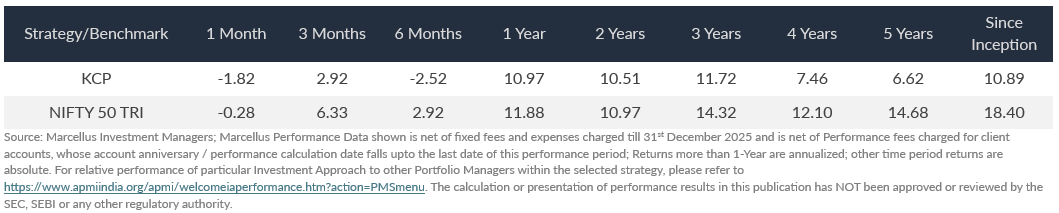
Kings of Capital
Our financial sector focused investment strategy with a portfolio of banks, NBFCs, life and general insurers, asset managers and brokers.
Portfolio Outlook
As CY25 ends, it is an appropriate time to reflect on the performance of the BFSI sector. At the start of the year, expectations were anchored around moderating loan growth, declining NIMs and concerns on asset quality. Contrary to these expectations, banks delivered resilient performance, with risks remaining largely manageable and product specific. This resulted in a strong sectoral outperformance during CY25, with Bank Nifty up ~16%, compared to ~6% for the BSE 500 and ~10% for the Nifty 50. Looking ahead, the earnings outlook for financial services companies appears to be improving, supported by a benign asset-quality environment and a gradual recovery in loan demand. However, risks persist from subdued deposit growth and the possibility of further policy rate cuts, which could pressure bank margins. In this context, we remain selective in our positioning and underweight large private sector banks. While we remain constructive on sector asset quality, growth is expected to be selective rather than broad-based, unlike the FY22–24 cycle. Our focus is on companies that faced asset-quality stress or growth slowdowns over the past 12–15 months and are now positioned for normalization. Additionally, recent corrections in select SMIDs have created pockets of value, which we are gradually incorporating into the portfolio.
What worked and what didn’t? Over the last 12 months, top detractors in KCP were CMS Info Systems and Info Edge. The top 3 contributors to the portfolio over the last 12 months have been Cholamandalam Finance, City Union Bank and Kotak Bank.
Performance of the scheme (Figures in %)
Ashvin Shetty
Portfolio Manager
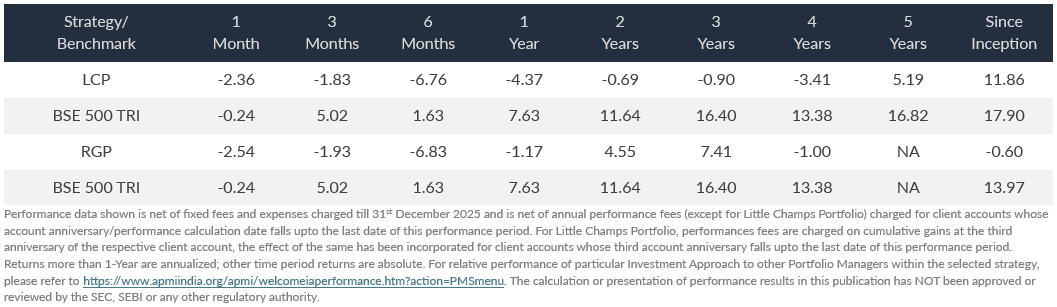
Little Champs & Rising Giants
SMID-cap strategies that invests in companies with good corporate governance, capital allocation track record and strong sustainable competitive advantages.
Portfolio Outlook
We continue to deploy cash in the portfolio stocks that have seen steep price corrections. However, this is being done judiciously balancing the risks surrounding the earnings (example – impact of US tariffs etc) and the valuation levels. On the positive side – (i) many of our export-oriented stocks are relatively unscathed from the US tariff impacts due to relatively low contribution (example – Garware) or having localised manufacturing set up (Jash Engineering). (ii) from the recent months exports data – we also see portfolio stocks diversifying their exports beyond the US markets (helping them mitigate the correction in US export volumes). The research team continues to work actively on expanding the investment coverage – giving us the ability to optimise portfolio earnings/valuation.
What worked and what didn’t?
Basis the last 3 months attribution ending on December 31, 2025– the key contributors to the portfolio have been City Union Bank, Acutaas Chemicals, and Real Estate Investment Trust (Reit) stocks. On the other hand, the key detractors have been Tarsons, Clean Science and Alkyl Amines. More generally, export oriented, IT stocks have been underperformed due to the situation around US tariffs whereas some chemical names in the portfolio have been impacted due to excessive supplies from China.
Performance of the scheme (Figures in %)
We believe in transparent communication and actively share our thoughts on various topics on our social media channels.