"The main reason investors struggle with how to react to bad news is that they really haven't figured out why they own the stocks they own." - Bill Nygren
Dear Unitholders,
We view risk somewhat differently than many market participants. To us, real investment risk is the risk of permanent loss of capital and the risk of an inadequate return. We believe this philosophical approach to risk is just as important, if not more so, particularly when focusing on solid long-term returns, than relying on industry standard risk metrics such as beta and standard deviation. For more reading on How Pender Thinks about Risk and protecting capital, see here.
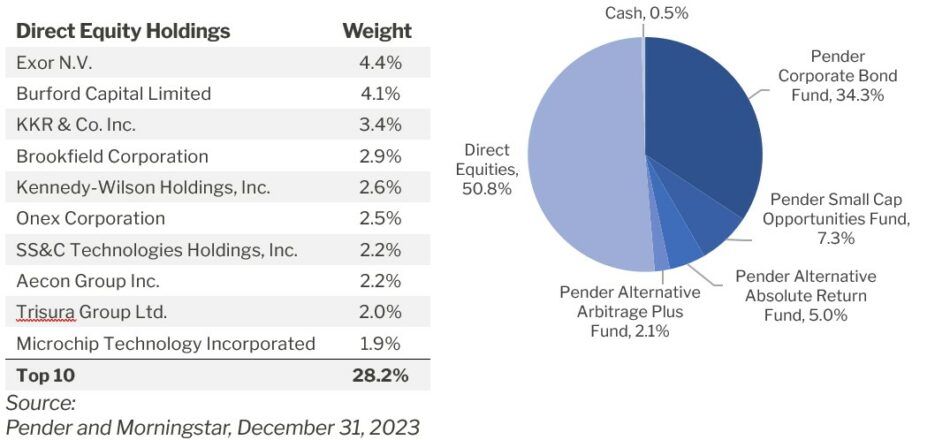
Pender Strategic Growth & Income Fund Asset Allocation
We generally trimmed our larger cap holdings and added to our smaller cap holdings where valuations were more favourable. Two new core holdings were added to the portfolio and we exited a holding at a modest loss when the facts changed. We added Interactive Brokers Group (NASD: IBKR) which provides low cost, seamless global access to the securities markets for both institutional and individual investors. It is a competitively advantaged business within a cyclical industry with a long runway. We also added Premium Brands Holdings (TSX: PBH), a Canadian specialty food manufacturing and distribution company. It is a growth by acquisition story and with a business model akin to publicly-traded private equity. The management team has demonstrated a long-term track record of smart capital allocation and prudent long-term strategic decision making. We own both securities in other Pender mandates and the recent price weakness enabled us to establish positions at attractive prices. We exited Liberty Broadband (NASD: LBRDK) due to our concerns of growing business and balance sheet risk. A levered equity story in a higher interest rate environment with weakening growth prospects were key indicators that the capital could be better deployed elsewhere.
Within our direct equity holdings, we had significant positive contributions in the quarter from KKR (NYSE: KKR) and Brookfield Corp (TSX: BN).
Our top detractors during the quarter included Baidu (NASD: BIDU) and Altius Renewable (TSX: ARR).
"We trimmed our larger cap holdings and added to our smaller cap holdings where valuations were more favourable."
Despite promise from its early bet “all in AI”, Baidu did not participate in the broad AI rally in 2023 because of market concerns about growing geopolitical risk and economic sluggishness in China. We have no special insight when, or if, these macro headwinds will dissipate. Or get worse. Still, we remain comfortable with a modest position. It is the Fund’s only holding domiciled in China. Baidu is arguably one of the most mispriced equities in the portfolio. The company is founder-led, has a robust balance sheet including net ‘cash & equivalent’ accounting for nearly half the market capitalization, a reliable free cash flow engine from its core marketing business, with multiple sources of optionality from its multi-year “All in AI” efforts.
We have seen the market adage “If it’s in the news, it’s in the price” play out countless times. By the time market concerns hit the proverbial “front page”, the level of real risk is often quite low because the securities have been already sold off to levels well below reasonable worst-case scenarios. Interestingly, shorting Chinese stocks is the second most crowded trade among global fund managers, according to a recent survey by Bank of America. It’s the opposite of that 90s sitcom, “Everybody Loves Raymond”. Things could get very interesting if today’s negative view changes.
Altius is a relatively thinly traded stock. Flows into and out of the stock tend to have a larger impact on the price over the short term than fundamentals – good or bad. As a first mover in the renewables sector, we view Altius as a well-managed, reputable, and experienced royalty operator. Renewable energy is a secular growth story, but there are a number of factors that make royalty streaming compelling as power purchase agreement lengths are shortening and tax incentives are phasing out. Royalties provide non-equity dilutive, covenant-lite and flexible financing. During the quarter there was a positive development and catalyst with its 50% owned operating subsidiary Great Bay Renewables announcing a new senior secured credit facility. In addition to its net cash position, Altius can now draw on the credit facility at an attractive rate to fund royalty investments without having to raise equity.
Our Canadian small and microcap exposure comes primarily through our holding of Pender Small Cap Opportunities Fund (PSCOF). The Fund generated performance in line with its category for the year in the high single-digit range which was below its historical robust double-digit long-term returns. It’s been a challenging small cap environment as the below valuation chart illustrates. Much of the small cap performance weakness has been due to valuation compression whereas large caps have benefited from a tailwind. We are still in a macro fund-flow driven environment.
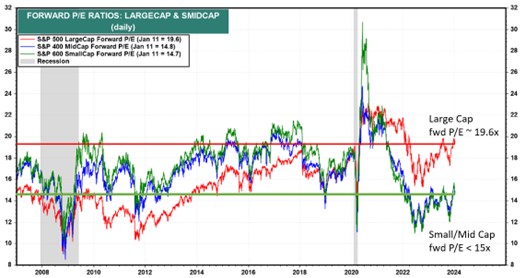
Source: LSEG Datastream and Yardini.com, Pender. As of January 2024
While this dynamic continues to favour large cap stocks over small, it does introduce significant volatility into the more liquid parts of the small cap market. During the fourth quarter the Russell 2000 hit its 52-week low on October 27 and recovered to its 52-week high only 42 days later – the quickest turnaround in history. This was driven by large investors seeking easy liquidity and exposure to an asset initially looking to take risk off the table and then looking to add on risk with a normalizing interest rate environment. Over the long term, PSCOF has been a significant performance generator for PSGIF. We are optimistic about better days ahead considering today’s relatively cheap small cap valuations as a starting point. For more details on PSCOF, see the fourth quarter update here.
Our fixed income investments are reflected by our position in the Pender Corporate Bond Fund (PCBF), which contributed positively to performance for both the quarter and the year. The overall approach is balanced across the fixed income opportunity set where it takes a counter-cyclical approach to duration and credit risk. In practice, this has generated favourable downside capture ratios for PCBF relative to its category and contributed to its positive long-term record. The Corporate Bond Fund yield to maturity at December 31 was 7.9% with current yield of 5.4% and average duration of maturity‐based instruments of 4.0 years.
Although the high yield index has soared higher, the same can’t be said for off-the-run and unrated bonds. Here, there is still an ample supply of bonds trading in the 50s and 60s percent of face value, where the value of the issuing companies appears to be clearly in excess of total debt outstanding. Double digit yields are still very much a thing. For more details on some of the opportunities we see in the PCBF, see the December portfolio update here.
In aggregate, our liquid alternatives positions generated a low-single digit return for the quarter and a high-single digit total return for the year. Both Funds are terrific portfolio diversifiers which should generate positive absolute return in most market conditions. These alternative strategies are designed to be more market neutral than the positioning of the rest of the PSGIF mandate. In practice, this usually means better performance in challenging markets but less upside when animal spirits become very bullish. This is achieved through paired shorting and event-driven strategies like merger arbitrage to dampen volatility while still providing decent long-term returns. These Funds were exemplary in 2022 generating positive returns when almost every other asset class and most strategies were in deeply in the red. The PAARF is generally positioned defensively today, with the December 31 yield at 3.2% while yield to maturity was 6.6%. For more details on the PAARF, see the December commentary here. For more details on the Pender Alternative Arbitrage Plus Fund (PAAP), see the December commentary for the unleveraged version of the Fund here.
Our portfolio activity was unusually elevated in the last quarter which should help set us up favourably in the coming years. Our equity exposure is tilted more balanced than peers, which means a higher allocation to competitively advantaged small-to-mid-sized companies which have more upside from a valuation perspective. Our fixed income position through PCBF and both liquid alternatives mandates are currently positioned relatively defensively. We expect these strategies will continue to help dampen volatility and provide some downside protection. When the market sentiment swings to fear again, and the opportunity set becomes more attractive, we are ready to tactically deploy capital.
Please do not hesitate to contact us, should you have questions or comments you wish to share with us.
Felix Narhi & Geoff Castle
January 19, 2024