Source: PenderFund; March 31, 2025
“Trade wars are good, and easy to win.” – Trump (Tweet, March 2, 2018)
Dear fellow unitholders,
While we had proactively repositioned the portfolio heading into 2025 with a more conservative stance, we underestimated the breadth and severity of the global tariff shock−especially its impact on companies with international supply chains and non-domestic revenue exposure. The abrupt imposition of sweeping tariffs by the US administration in early April created a ripple effect across markets. This accelerated capital outflows from risk assets and exposed vulnerabilities we had expected to be more insulated.
Source: PenderFund; March 31, 2025
We monitor high yield spreads closely strategically guide future allocations into higher-yielding securities, primarily through the Pender Corporate Bond Fund, should spreads widen meaningfully. In the meantime, we are tactically upgrading the quality of the portfolio by taking advantage of volatility-driven mispricings.

Source: PenderFund; March 31, 2025
Two of our top three contributors this quarter were Molina Healthcare, Inc. (MOH) and Elevance Health, Inc. (ELV), healthcare holdings we added in the fourth quarter of 2024 to strengthen our defensive positioning. However, these gains were more than offset by the decline in Maravai Lifesciences Holdings Inc (MRVI), another healthcare investment, which faced a trifecta of unexpected headwinds: 1) a weaker-than-expected 2025 outlook; 2) delayed financials, and; 3) headwinds from Robert F. Kennedy, Jr's initiatives focused on cutting healthcare costs which combined to add uncertainty to its growth outlook. Despite near-term challenges, we remain constructive about Maravai’s long-term optionality and believe its strategic value to potential acquirers offers meaningful downside protection. In investing, when the outlook is obviously strong, the price typically reflects it—and when the price is attractive, the outlook is often clouded by uncertainty. We modestly added to our position in the quarter.
There could be some value-unlocking catalysts ahead for some other holdings as well. For example, Clarivate Plc (CLVT) is exploring the sale of its intellectual property (IP) unit amid strong private equity interest, a move that underscores how rational, long-term actors will seize opportunities when public markets undervalue assets for too long. If the sale proceeds at the valuation levels Clarivate expects, it would highlight significant mispricing by public shareholders and could serve as a catalyst for a major revaluation and upside in Clarivate’s stock.
We sold Calian to make room for more compelling opportunities that emerged in a volatile quarter. We also exited Genmab after Johnson & Johnson decided that it would not exercise its option to commercialize its potential blockbuster, HexaBody-CD38. When better opportunities become available or risk-adjusted return estimates decline, it is prudent to take action.
During the quarter, we initiated new positions in Fevertree Drinks and Lithia Motors—two businesses that align with our focus on quality, valuation support, and long-term growth optionality.
Fevertree is a premium mixer brand which is undergoing a significant reset following a period marked by cost inflation and pandemic-era supply chain challenges. Despite near-term earnings volatility, we believe the market is overlooking a major catalyst: the recently announced US distribution agreement with Molson Coors. This partnership is a potential game changer, providing Fevertree with a scaled and efficient route to market across North America—its largest long-term growth opportunity. With Molson Coors' deep distribution network and established relationships in the on- and off-trade channels, Fevertree is now better positioned to accelerate brand awareness and shelf space across the US, while maintaining focus on product innovation and brand integrity. Combined with its asset-light model, strong brand equity and a founder-influenced culture of quality and signs of margin recovery as input costs normalize, we see a compelling risk-reward opportunity at current valuation levels.
Lithia Motors is one of the largest automotive retailers in North America, with a unique strategy of combining physical dealership acquisitions with an ambitious digital platform rollout. While the automotive retail space is cyclical and currently facing normalization post-COVID, LAD’s disciplined capital allocation, strong free cash flow generation and ability to consolidate a fragmented industry offer long-term compounding potential. Importantly, LAD continues to show the benefits of its diversified ecosystem, even with tariffs on imported vehicles throwing the auto industry into disarray in recent weeks. It operates within one of the largest and least consolidated industries. We view LAD as a rare public market proxy for private equity-style consolidation in an essential service sector, with upside driven by operational leverage and multiple expansion as macro conditions stabilize.
Periodic market dislocations open attractive entry points for world-class companies that are not usually available at sensible valuations. We also added Danaher (DHR), Louis Vuitton Moët Hennessy (LVMUY) and Applied Materials (AMAT) in April following their significant drawdowns. These companies are leaders in their respective industries and have long histories of growing shareholder value. We will provide further commentary in our Q2 letter.
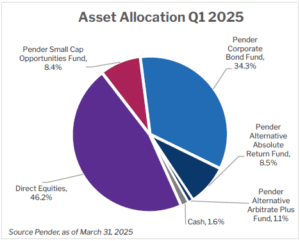
Fixed Income (Pender Corporate Bond Fund, 34.3% of Fund): PCBF outperformed during the quarter with a 1.9%1 return. From a big picture point of view, our fixed income team sees enormous opportunities in several areas because of the volatility caused by the actions of the Trump administration II. During the quarter PCBF was also awarded a FundGrade A+ Award3, the sixth consecutive year that it has been honoured with this award, demonstrating consistent outperformance on a risk-adjusted basis. We modestly increased our allocation to PCBF during the quarter. For further details, see the March portfolio update.
Liquid Alternatives (Pender Absolute Return Fund & Pender Absolute Arbitrage Plus, 9.5% of Fund): Overall, these positions posted a low single-digit return during the quarter. While the implications of a large re-set to global trade are understandably cause for concern, we believe that volatility and fear present opportunities. As yields increase, so will forward returns. It looks to us like 2025 will present more opportunities and dislocations than we saw in 2024. The allocation to liquid alternatives increased from 7.1% at the end of 2023 to 9.5% today, remaining below the regulatory maximum of 10%. For additional details on the Pender Alternative Absolute Return Fund, see the March portfolio update.
Small Cap Equities (Pender Small Cap Opportunities Fund, 8.4% of Fund): PSCOF declined 11.7%1 in the first quarter, reflecting challenges typically experienced by small-cap stocks during risk-off periods. While past performance is not a guarantee of future outcomes, PSCOF continues to provide differentiated exposure for the Fund, particularly in an environment where equity allocations in many balanced strategies remain heavily weighted toward large-cap index holdings.
Aggressive policy shifts during President Trump’s second term—including rising protectionism, deregulation and a more disruptive foreign policy stance—are fueling heightened uncertainty, dampening economic growth and increasing the risk of global de-dollarization. Although some AI-driven investment enthusiasm persists, broader market valuations still remain elevated, and signs of a bear market are becoming apparent amid weakening consumer sentiment, widespread job cuts and the impact of escalating tariffs. The resulting economic slowdown could potentially tip into a recession, exacerbated by the prospect of long-term inflationary pressures and threats to US financial dominance.
While a shock at first, this broader narrative is now widely recognized. The market is no longer making new highs, and many individual stocks have been "taken to the woodshed," suffering significant drawdowns in their prices. At least some of this risk is reflected in current valuations—but the question remains: how much has already been priced in? On the other hand, while high yield spreads are well off their multidecade lows in January 2025, they are still nowhere near the distressed levels we have seen in previous downturns. If history is a guide, there could be more downside ahead. As always, we seek to find balance and continue to act in an uncertain world. "Predicting rain doesn’t count. Building arks does."
Thank you for your continued support, and please do not hesitate to contact any of us should you have any suggestions, questions, comments, or ideas you wish to share.
Felix Narhi & Geoff Castle
April 30, 2025