“You can ignore reality, but you cannot ignore the consequences of ignoring reality.“
– Ayn Rand
Michael Crichton, renowned for his best-selling novels such as Jurassic Park, The Andromeda Strain, and Westworld, left a lasting impact on both literature and film. Crichton was one of the most successful novelists of his generation, admired for incorporating meticulous scientific research in his books. In 2002, Crichton gave a speech titled “Why Speculate?” in which Crichton critiques the growing frequency of speculation in modern media. Crichton argued that speculation has largely replaced factual reporting with unsupported predictions, suggesting that this trend is so pervasive that demonstrating a factual basis for claims is no longer expected. Front-page stories filled with vague predictions are useless because no one can predict the future with certainty.
A key concept introduced in the speech was the “Gell-Mann Amnesia effect,” named after physicist Murray Gell-Mann.[1] Crichton described this as the tendency of people to believe media reports on topics they know little about, even after encountering blatantly inaccurate coverage of subjects they understand well. For instance, an expert in physics might dismiss a poorly researched article directly related to their field of expertise, but then instinctively trust the following story on international affairs, granting undeserved credibility to the media. Typically, if someone consistently exaggerates or lies, one soon discounts everything they say. In court, Crichton noted, there is the legal doctrine of falsus in uno, falsus in omnibus, which means untruthful in one part, untruthful in all. However, when it comes to the media, we believe, despite the evidence, that it is worth our time to read other parts of the paper. Perhaps amnesia explains this odd behavior. One problem with speculation is that it piggybacks on the Gell-Mann effect, which lends unwarranted credibility, making the speculation appear more valuable than it is.
Nobody knows the future. To illustrate that point, Crichton referenced a column written by Washington Post columnist Art Buchwald during President Johnson’s administration. Buchwald wrote a “Thank God we don’t have Barry Goldwater” essay, recalling how everyone feared that Goldwater would lead the country into a major war. Instead, the country elected Johnson, who promptly committed 200,000 troops to Vietnam. Crichton pointed out that we elected the intellectually brilliant Jimmy Carter and then watched as he spent his time personally deciding who gets to use the White House tennis courts. We elected Richard Nixon because he would end the war in Vietnam, but he continued the war for years… But then Nixon unexpectedly opens China to the West.
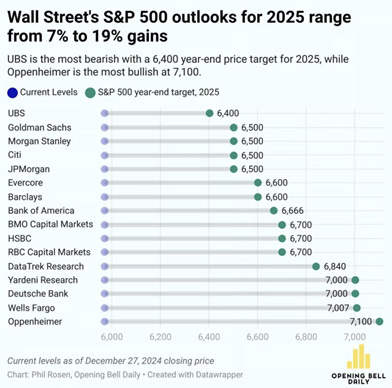
If speculation is worthless, why is there so much of it? Because the speculator cannot lose, posited Crichton. Even though the speculator is correct only by chance, meaning they are wrong at least 50% of the time, nobody remembers, and therefore nobody cares. The speculator is never held accountable. The audience does not remember yesterday, let alone last week or last month. Wall Street analysts and the financial media often prioritize forecasts, such as stock price targets, economic outlooks, or company earnings projections, over concrete, verifiable data. Wall Street speculation frequently hinges on vague or untestable assumptions, such as how a geopolitical event or a new tariff structure might affect the stock market. Speculation can drive market movements more than fundamentals, much like how media narratives shape public opinion.
Crichton’s “Gell-Mann Amnesia effect” has a direct counterpart on Wall Street. Investors may dismiss a flawed analyst report or overhyped stock price target in one instance yet quickly believe the subsequent speculative narrative about a different company or sector. The dot-com crash exposed rampant over-speculation, but market participants soon embraced similar hype surrounding subprime mortgages, all but forgetting the lessons of the technology bubble. This amnesia fuels speculative manias, as market participants repeatedly trust unverified predictions despite past inaccuracies. Research from the CXO Advisory Group indicates that stock market predictions by experts are correct roughly as often as random guessing, with an accuracy of around 47% over several decades. Yet, Wall Street thrives on the authority of CNBC commentators, hedge fund managers, or “star” analysts, whose never-ending speculative calls—today it is artificial intelligence, or AI—drive trading volume and influence investor behavior.
Speculative narratives manipulate audiences when presented as authoritative. On Wall Street, this manifests in Wall Street analyst upgrades and downgrades, as well as media-driven hype surrounding IPOs (most recently, CoreWeave, an AI infrastructure company), and meme stocks (e.g., GameStop in 2021). These speculative stories—often detached from a company’s fundamentals—exploit investor psychology, creating volatility and transferring wealth from the credulous to company executives who exercise their stock options and sell into the euphoria. Individual investors have pumped nearly $70 billion into US stocks this year, even as Wall Street reduces its market exposure. Net inflows from retail investors into US equities and exchange-traded funds totaled $67 billion in 2025, according to data provider VandaTrack.[2] Individual investors remain upbeat about stocks despite the intense turbulence this year, and why not? Wall Street has told investors to expect another great year in stock market returns.
“Dip-buying has been an essentially foolproof strategy for four of the past five years,” said Steve Sosnick, chief market strategist at Interactive Brokers, a platform widely used by individual retail traders. Doing something that works remarkably well for so long conditions one to stick with it. A user on Reddit’s “r/wallstreetbets” discussion board, a popular chat room among amateur investors, offered a similar sentiment: “respect the dip, be the dip, BUY THE DIP!” they said. Tesla has now lost about half its value since its December peak and still trades at valuations a prudent investor would struggle to justify. Yet, retail investors remain mesmerized by the falling knife. JPMorgan’s “Retail Radar” weekly report reveals that “buy the dip” remains alive and well. During the week of March 17, retail traders purchased a record net $12.5 billion in stocks. According to JPMorgan, individual stocks accounted for $8.3 billion of the inflow, with Tesla and Nvidia receiving more than half. Notably, retail investors have been buying TSLA for twelve consecutive days, adding a total of $7.3 billion, the largest magnitude among all past buying streaks in over a decade.[3]
One cannot ignore the importance that government deficits play in the stock market’s post-2020 ascent. US government fiscal spending has sustained investor and consumer sentiment, as well as corporate profits. Technology companies benefited disproportionately from the government’s post-COVID deficits, which subsequently fed into enormous capital expenditures for AI. Now, as the government retrenches, it does not take much imagination to venture that the stock market will face headwinds. Through simple observation, it is evident that government borrowing has had a profoundly positive impact on the stock market. The cumulative change in the government’s fiscal deficit has lagged the change in the S&P’s market value for the past two decades. That abruptly changed with the pandemic. The government spent without restraint, coupled with the US Federal Reserve’s extraordinarily loose monetary policy, and unleashed the stock market’s animal spirits. The stock market’s value has risen twice as much as the government borrowed over the last five years.
Inflating stock prices was never an explicit goal of the government’s massive spending programs, but it certainly helped the US Treasury issue multiple trillions of dollars in US debt. However, there is now a concerted effort to address the size of the annual operating budget deficit in the US. The deficit is likely to stop rising, which is positive for the country in the long term, but potentially quite painful for stockholders in the short term. Economists have included government spending in the country’s gross domestic product (GDP) calculation since 1934, when most governments worldwide were incurring budget deficits to combat the Great Depression. John Maynard Keynes, the world’s most respected economist at the time, agreed with this spending, arguing that it did not matter where the demand came from, whether it was from consumers, producers, or the government. All that matters is that there is demand and the money to pay for it, even if it must be printed.
Ever since, government statisticians have continued with these methods of calculation, despite growing doubts. Murray Rothbard, an American economist who co-founded the Mises Institute, wrote in 1962 that the way the government collected output made no sense. Rothbard’s book, “Man, Economy, and State,” offered a detailed critique, demanding that economists either analyze the data correctly or cease attempting to collect it altogether. Rothbard wrote:
“Since governmental services are not tested on the free market, there is no possible way of measuring the government’s alleged “productive contribution.” All government services, as we have seen, are monopolized and inefficiently supplied. Clearly, if they are worth anything, they are worth far less than their cost in money. Furthermore, the government’s tax revenue and deficit revenue are both burdens imposed on production, and the nature of this burden should be recognized.”[4]
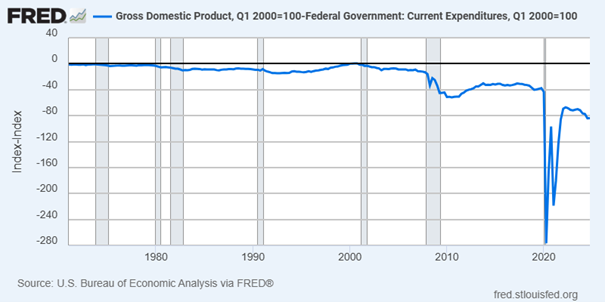
There is now a growing movement among economists that suggests reporting GDP excluding government spending. That movement may have merit according to macroeconomic analyst Luke Gromen, founder of Forest Through the Trees, who calculated an index of nominal GDP minus federal government outlays to better understand what the US GDP is, excluding government spending. Gromen determined that, excluding government spending and transfer payments, the US private sector economy has essentially been in a long, silent depression since 2000, interrupted only by the housing bubble, “Everything Bubble 1.0” (2013-19) and “Everything Bubble 2.0” (2020-1Q22).[5] Governments typically use fiscal policy to stimulate a weak economy – government spending increases during recessions and then decreases as the economy recovers, helping to reduce the deficit. That did not happen between 2021 and 2024; the government continued to spend freely, even as the economy recovered from the 2020 recession and the COVID-19 lockdown crisis. Gromen argues that for over two decades, the US economy has been driven by government spending and rising stock prices.
Almost all new investors want to understand why the market behaves the way it does. Over time, one learns that markets move before an apparent reason emerges. Even with today’s unlimited news and data feeds at one’s fingertips, this behavior persists. There is little use or benefit in trying to pinpoint exact reasons for short-term market shifts. Wall Street often wrongly claims it predicted these random market events. Forecasters mistake the randomness of events for self-generated intellect. In the 1950s, Dr. William Deming performed a simple experiment. Deming, long overlooked in the United States, gained fame in Japan for revolutionizing industrial quality control and management. He designed the experiment to illustrate the adverse effects of changing a process without carefully studying the causes of variation. He dropped a marble through a funnel onto a target below, aiming to have the marble come to rest at the center of the bullseye. Deming compared various strategies for improving accuracy and found that adjusting the position of the funnel after every drop by reacting immediately to every error led to an increase in variability and worsening accuracy over time. The best results were achieved by maintaining a consistent approach and adjusting only after methodically observing patterns of bias across multiple trials.
Similarly, maintaining a sound investment philosophy, along with a disciplined investment process, provides the prudent investor with a path to follow during uncertain and sometimes hostile investment environments. This framework ensures focus and rational thinking to guard against the permanent impairment of one’s precious investment capital. In this backdrop, one should consider oneself a part-owner of a business, a more cultivated word for a long-term investor. The intent remains to own fundamentally strong companies led by management teams who understand the importance of a disciplined approach to capital allocation. Once the investor internalizes this philosophy, they stop paying attention to current news and politics, the latest macro data, or quarterly earnings. The investor anticipates and discounts the future along a range of probabilistic outcomes. The past and present are useless. By the time the news explains a market move, it has already been factored into the price. Successful investors focus on fundamentals and positioning, rather than chasing after narratives.
With crude oil prices dropping to $70 a barrel or less, Wall Street is once again narrating the end of the energy cycle that began in late 2020. Misplaced fears have pressured the stock prices of energy companies, including those in the midstream energy sector. Midstream energy companies are responsible for everything that occurs from the time operators pump oil and gas out of the ground to when finished products reach the market. At every step of the process, midstream companies collect fees. While some midstream companies have exposure to commodity prices and volumes shipped, most midstream companies operate under contracts that are capacity-based or “take-or-pay,” meaning the cash flow comes in at a set rate, often with escalators tied to inflation. This market structure provides a reliable cash flow for midstream companies. Unlike many companies in corporate America, midstream companies mainly operate within their means by funding capital spending, debt service, and dividends from operating cash flow. By doing so, midstream companies are well-equipped to handle potential recessions or market volatility.
After years of stagnant growth, US electric utilities have been experiencing their most significant demand increases for electricity since the 1960s. Natural gas-powered generation is the most economical way to meet this demand. However, since the election in November, Wall Street has been concerned that the new administration's policies may lead to an overproduction of oil and gas, resulting in an oversupplied market. Lower commodity prices typically result in lower projected earnings. Yet, energy companies remain highly disciplined with their capital allocation decisions. Production increases match demand projections, such as future LNG export facilities or demand for electric power plants. Energy companies no longer ramp up production just for “volume growth,” as Wall Street analysts demanded in the previous decade. Midstream energy companies remain conservatively focused, utilizing their free cash flow to reinvest in their operations, reduce debt, repurchase shares, and pay distributions.
As retail investors diligently “buy the dip” in Nvidia’s stock, the prudent investor might compare Nvidia’s 5.6% weighting in the S&P 500 Index against the 3.7% weighting for the entire energy sector, all twenty-two companies. Refusing to participate in a speculative frenzy comes at a price—one must be able to swim against the tide, not just for days or weeks, but for years. In the late 1990s, the investment world became enamored with technology stocks. Foundry Networks went public in September 1999 and jumped 525% on its first day. By December 31, 1999, it returned 1,092% from its IPO just three months earlier. Qualcomm surged nearly 2,000% in 1999. Cisco Systems’ market value increased by 5000% in five years, briefly becoming the most valuable company in the world.
During the internet bubble, famed investor Warren Buffett received scorn for not investing in the stock market darlings of the day. In 1999, Barron's, one of the oldest and most influential financial publications, published “What’s Wrong, Warren?”, stating, “After more than 30 years of unrivaled investment success, Warren Buffett may be losing his magic touch.”[6] While market participants obsessed over technology stocks, Buffett noticed that valuations were becoming ridiculous, far outpacing company fundamentals. Every investor or speculator knows exactly how the dot-com technology bubble ended, but imagine how difficult it must have been for Buffett to stick to his principles while being criticized for investment prudence.
Buffett even faced criticism on Internet message boards, with one post describing Buffett’s Berkshire Hathaway as a "middlebrow insurance company studded with a bizarre mélange of assets, including candy stores, hamburger stands, jewelry shops, a shoemaker and a third-rate encyclopedia company." Upholding one’s beliefs, investment thesis, and principles when the world shouts otherwise is more challenging in practice than in theory. Since the publication of that article in Barron’s, Warren Buffett’s Berkshire Hathaway has produced a total return of 1,360%, compared to the S&P 500’s total return of 525%, resulting in a difference of 11.1% versus 7.8% in compounded annual investment returns over more than a twenty-five year period.
Michael Crichton contrasted the flood of speculation with the possibility of certainty through rigorous investigation and data. Crichton lamented that society had become so accustomed to unverified opinions that the effort required to establish facts feels foreign or excessive to most. He urged recognition that while some things are unknowable, many can be resolved, not through guesswork, but through disciplined inquiry and analysis. The investor may only learn with the benefit of hindsight why market events transpired. However, the investor can resolve many questions, not by speculation, but by careful investigation and rigorous analysis. Investors operate in a market awash with such speculation and unsupported opinions that the distance separating analysis from speculation is now unfamiliar to many market participants.
As Mark Twain once said, “There are two times in a man’s life when he should not speculate: when he can’t afford it and when he can.“ Contrast speculation with the effort of seeking certainty through fundamental data and rigorous analysis. On Wall Street, speculative trading often overshadows disciplined, fundamentals-based investment. Value investors, such as Warren Buffett, who focus on a company’s intrinsic worth rather than market hype or narrative, embody this call for rigor. Yet, the market’s speculative culture discourages this patience, much as Crichton laments society’s addiction to quick, baseless opinions. Investors chasing speculative gains risk the pitfalls Crichton highlights: wasted effort, misplaced trust, and manipulation.
Investors should always question the hype and seek substance in their analysis. And therein lies the opportunity for today’s value investor, who seeks to identify fundamental discrepancies between a company’s market price and its intrinsic value. Passive index funds have turned the index’s largest companies by market value into momentum stocks. Technology-backed AI companies dominate today’s headlines, just as non-fungible tokens (NFTs), special purpose acquisition companies (SPACs), decentralized finance (DeFi), and meme stocks dominated headlines of the past. Investment opportunities will always persist for the patient and prudent investor willing to look elsewhere and dedicate the time and effort to fundamentally research these investment prospects.
With kind regards,
St. James Investment Company
[1] Michael Crichton, "Why Speculate?" Law of Markets, April 13, 2020.
[2] George Steer, “Retail Traders Plough into US Stocks,” Financial Times, March 25, 205.
[3] Robin Wigglesworth, “Retail Traders are BTFD in Tesla,” FT Alphaville, March 20, 2025.
[4] Murray Rothbard, “Man, Economy, and State,” Princeton: Van Nostrand, 1962, Page 1293.
[5] Luke Gromen, FFTT Tree Rings, March 7, 2025, Page 17.
[6] Andrew Bary, “What’s Wrong, Warren?” Barron’s Magazine, December 27, 1999.