Now that Q2 REIT earnings are wrapped up, I wanted to share some thoughts on the REIT and CRE markets. But first a little general update, as a lot has happened since my last article - if you are only here for the real estate feel free to skip this next bit.
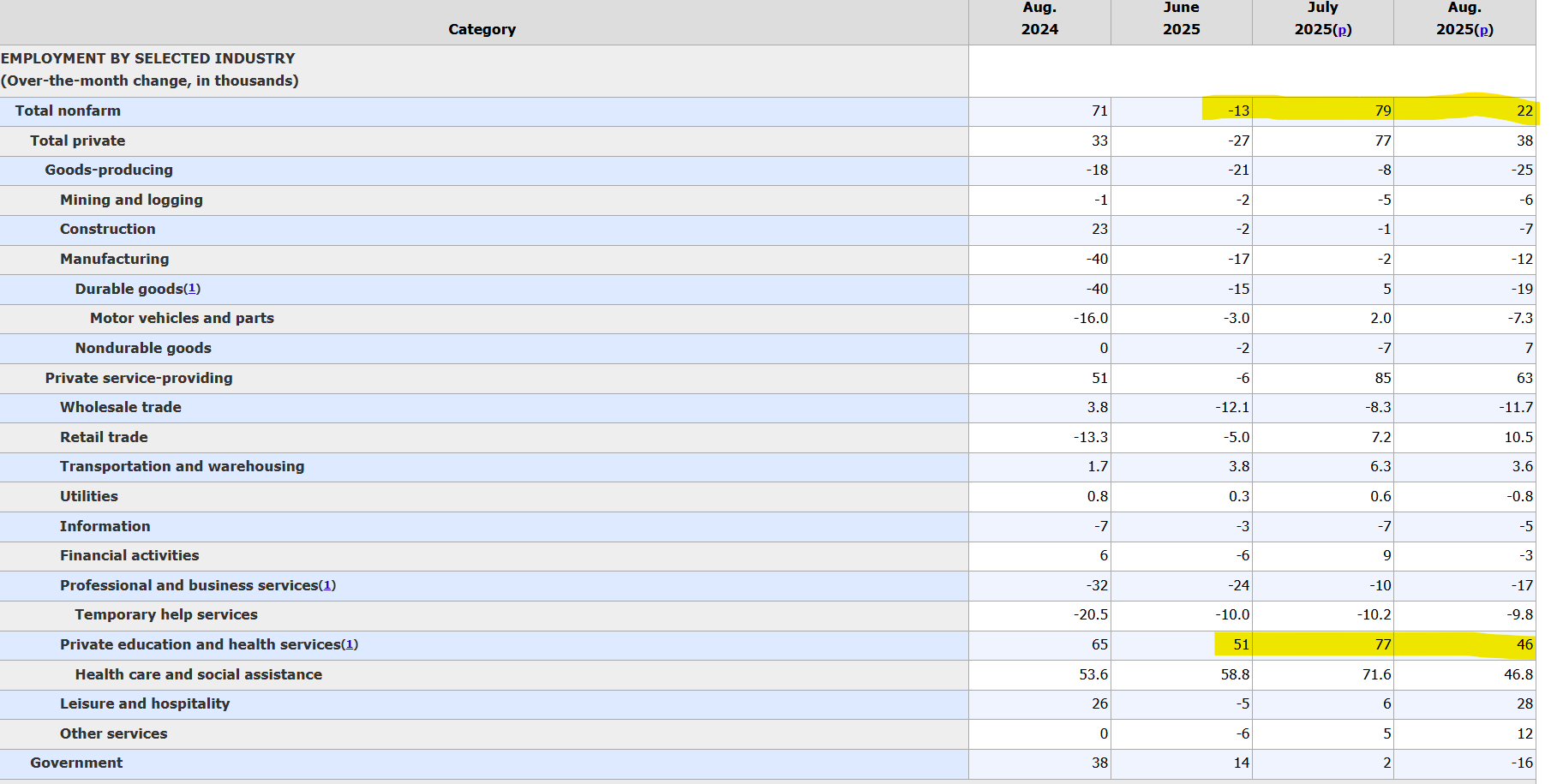
The biggest overall macro change since my last update was probably the weak August jobs release, with only 22k jobs added, and the previous big negative jobs revisions for the July jobs release, where June and May jobs numbers were each revised down by over 100k1. Job growth was negative in June, which is the first negative month since covid, and if you dig into the numbers basically all the growth we did have in July and August was concentrated in the Education and Health Services sector.
Now if you have been following the numbers you would know that this category (along with leisure & hospitality) has been the main jobs driver for several months now - the main difference is now the headline number is slowing as well. This is a problem because healthcare is simply not a driver of actual economic growth, it just reflects an aging populace and ever increasing government spending2.
Adding to the negative jobs news, the semi annual adjustments of the BLS estimates to match with lagging state level payroll tax data just released September 9th, and it was a quite large downward revision of ~ -910k to the total jobs added for the year ending March 31, 2025. If there is a similar downward revision to the current numbers, job growth would have been basically negative since April. 5 months of negative job growth is pretty much unprecedented outside of a recession, so this is a very concerning development.
Interestingly unemployment hasn’t increased all that much, yet, although it is up ~30 bps since the January low. More worryingly is that labor force participation has declined a good bit, which offsets unemployment rising. If you held this rate constant at April’s level, unemployment would be much higher.
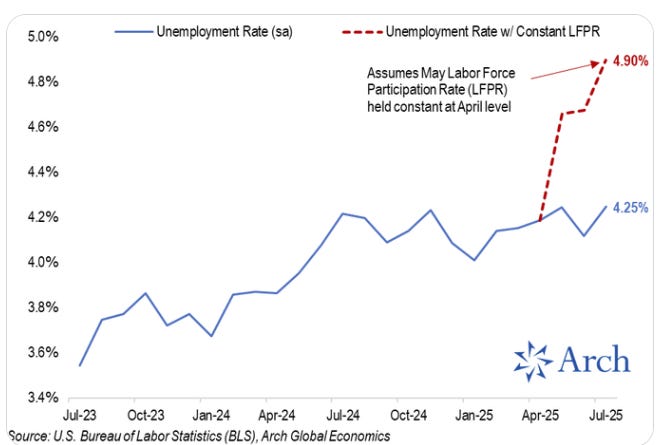
Chart from Parker Ross, handle @Econ_Parker on Twitter.
That said, prime age participation is still high, so it is hard to read too much into this stat on its own. But taken together with a constellation of other factors and it is worrying.
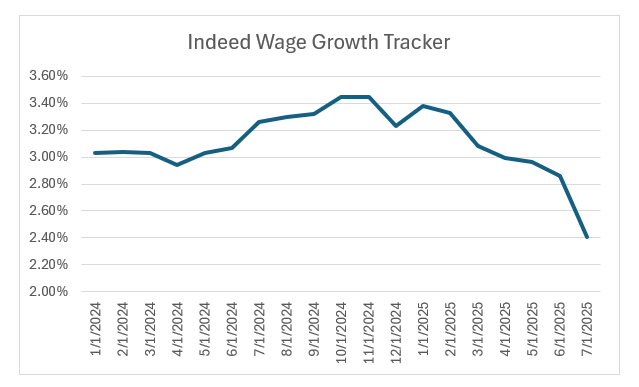
Further, the economy’s breakeven job growth figure is much lower likely due to decreased immigration, so the lower growth may not be quite as bad on a population growth adjusted basis. But we may be getting close to a tipping point. Another negative indicator is wage growth - the Indeed wage growth data has taken a big turn down recently3.
Total hours worked is also down quarter over quarter by ~-0.3%, but is relatively flat within this quarter.
So we are seeing several leading labor market indicators stalling out or deteriorating, and rapidly. I fear we may be at the inflection point of reaching a recession. Yet stocks are close to all time highs, a risk reward ratio that feels quite poor.
Government spending and the AI boom have been propping up growth, but the slowdown in the rest of the economy may be beginning to outpace these factors.
And speaking of the AI boom, the other big piece of news we had was GPT 5 also released earlier in August, and the results have been pretty underwhelming.
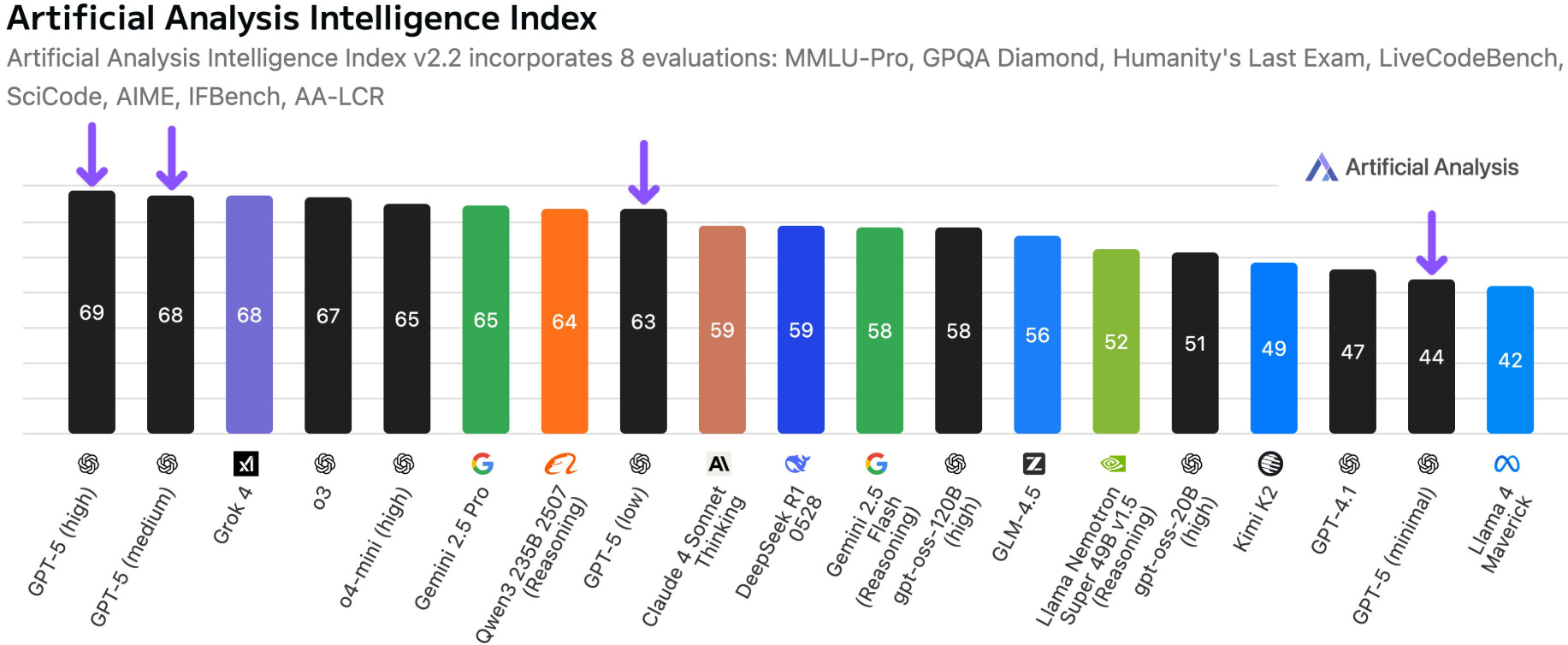
Here are Artificial Analysis’s rankings - basically GPT 5 is barely any better than Grok 4, or surprisingly even OpenAI’s own o3. This has led to what I believe is the beginning of a vibe shift among tech and AI types, with Altman himself even essentially saying in an interview that AI was a bubble4.
I think this is a really big deal that the market isn’t appreciating. If scaling has run out of steam, that means even the biggest AI bulls are going to have a hard time justifying the next step up in model training scaling. And that means model training capex spend should fall dramatically, and soon5. Given AI related capex seems to be running around ~$400 billion a year, this is a huge deal economically.
My guess is that AI capex begins to slow in Q1 2026, as the last round of announced and financed build outs are completed (specifically xAI’s Grok 5, Meta’s next mega cluster, OpenAI’s next round of clusters, and general Blackwell deployments)6. This could be a catalyst for the whole AI bubble to begin to burst as some of the hype begins to fade. This subject really deserves its own post, but the key take away here is that it looks like our last major economic driver ex government spending may be on its last legs, right as the overall economy is slowing down even further. It feels like a dangerous combination.
That said big tech earnings have been very good so far, and AI related end user spending growth has been very strong (albeit way below the levels required to justify the capex wave). So if that spending continues to scale rapidly the party could keep going for awhile longer.
OK back to real estate and my investments.
The biggest news for me is a buyout offer for Plymouth Industrial. Plymouth is an industrial REIT focused on assets in secondary markets in the midwest and a bit of southeast - mostly slower growth markets but with higher yields compared to more coastal or core markets.
I was intending to give Plymouth a bit of a spotlight in this letter, as it was my largest position by a good margin. But now it probably isn’t worth spending as much time on, because the value gap is significantly smaller. The stock was sub $15, and Sixth Street made an offer for ~$24 / share. My NAV is $27 - the stock is at ~$21-22 today and so what is left is more of an event type situation. This might still be interesting for a different set of reasons, but I won’t go into it here.
This is just such a great example of the inefficiencies in the REIT space. Plymouth was trading as low as a ~9.25% cap rate, when their assets are likely worth around a ~7% cap rate. It is hard to say exactly why it got so cheap, but this gap was far too large in my view7.
What is crazy here to me is that unlike other cheap REITs, Plymouth had good operating results! The other examples of huge public/private value gaps are in the hotel space, where earnings have been meh, and office, where there has been huge disruption from remote work. In other words, situations where conceivably the private values might be headed a good bit lower. This is not the case in industrial.8
So, a very nice win for me here, although I wish I had owned even more in hindsight. This also just reemphasizes to me the importance of bet sizing - it is rare to find something so clean with minimal downside and strong upside, and so a big swing is warranted in these kind of scenarios.
Onward to some sector specific commentary.
Elsewhere in industrial, several other REITs trade at moderate NAV discounts, albeit much smaller than Plymouth. This is despite good NOI growth, which is driven by continued mark to market of rents catching up to the covid era boom. The reason here I believe is that industrial fundamentals have continued to soften due to weak demand and a supply hangover from the last boom. Deliveries have fallen off dramatically and continue to decline (along with starts), so this should provide a little bit of relief. But once the industrial REITs have completed their mark to market on rents, NOI growth should slow dramatically given overall market conditions are fairly soft. Still, the discounts available in the public markets combined with the last of the rental increases makes for fairly attractive stabilized yields in a few years, and a few REITs are interesting here.
Office continues more of what we saw in Q1, which is an ongoing uneven recovery that has picked up steam in 2025 vs the last two years. High quality buildings are doing much better than lower end, and performance across markets is also highly varied.
A good example of this can be seen in the occupancy over time of the office REIT Cousins, which owns primarily class A sunbelt assets. Cousins’ physical occupancy is basically back to the lower end of pre-covid figures, and their leased occupancy is 1-2% off. The last few quarters have been quite strong, and at this rate they may well get there by early 2026 barring a downturn.
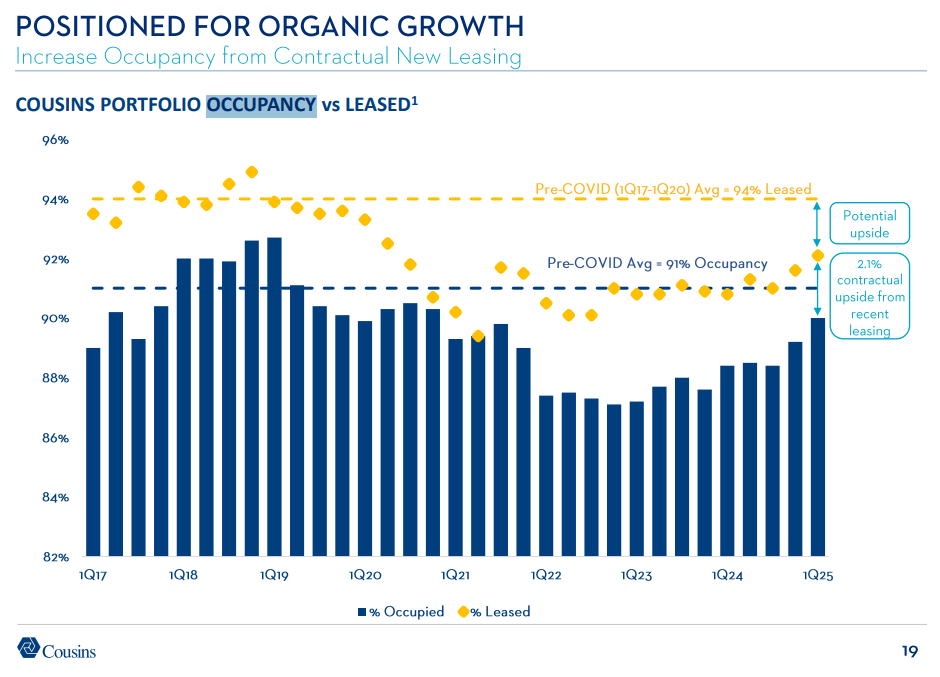
Compared to overall office occupancy levels in its markets, Cousins is outperforming by a good deal. Taking a look at Atlanta (their largest market), we can see that overall market vacancy is around ~17.5%, down from a high of over 19%, but still well up from the ~14% pre-covid levels still. This weaker performance highlights the flight to quality trend we are seeing in office space.
Market wise, NYC continues to lead the pack, with vacancy down to ~14-15% depending on the data provider. Interestingly the visits data is back above precovid at least by the measure of one data provider, Placer.ai, although it really isn’t clear to me how that can be the case given the lower occupancy figures today. Certainly anecdotally to me walking around midtown it feels as busy as ever.
The west coast continues to lag, but the quarter over quarter leasing gains have been quite strong for SF and Seattle to a lesser degree. The size of the hole is still very large, but AI is finally starting to show some dividends for the west coast tech markets & the tide has hopefully turned out there. While I am concerned about an AI bubble, the actual employment here is still quite small and I do think long term the sector will be quite significant. So I believe AI will be a nice demand driver over the long term even if in the short run things soften.
Finally, and this saddens me greatly to report but REIT BXP is starting a huge new midtown Manhattan development at a combined basis $2.1k psf, which would be a record. This historically has been one of the great problems with the office sector, that it has some of the most aggressive developers of any asset class and a continual propensity to build more supply than the market needs.9 Given VNO and SLG have also talked about new developments, I worry that NYC’s nascent landlord’s market may be hobbled by new supply before it even gets off the ground. Hopefully we get a few good years in at least.
In the residential rental space we continue to see sunbelt weakness with relative coastal strength. This is easily seen in EQR’s market but market results below.
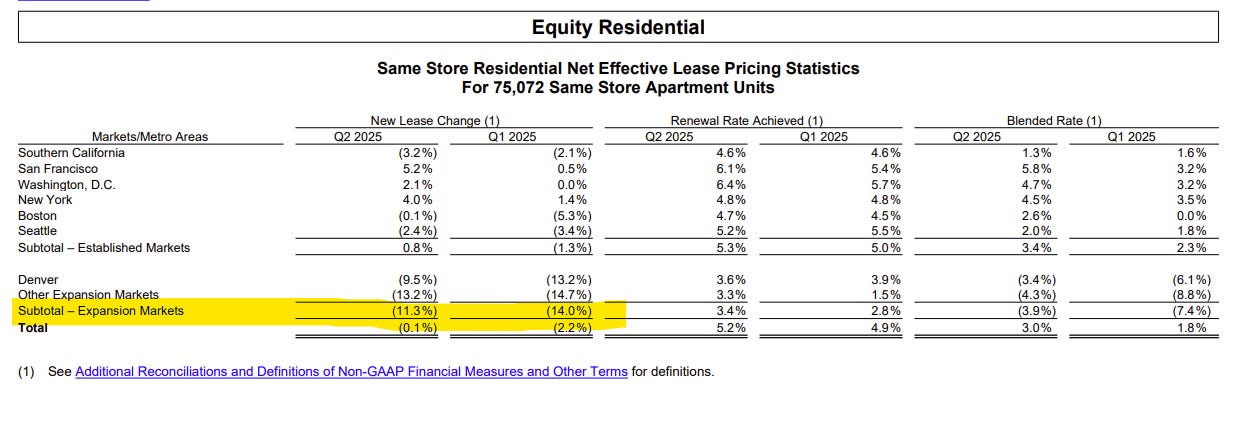
Other expansion markets are mostly Atlanta and Dallas with a bit of Austin.
To me the most interesting thing is just how weak the Sunbelt remains - negative 10% YoY new rent growth is absolutely brutal. But, it is a bit better than Q1.
The next most interesting thing is the acceleration in San Francisco. The REITs spoke about this a bit in Q1, but that market seems to have really starting to blow up here in Q2. Anecdotally I also see & hear people complaining that the market has begun to get a bit crazy out there, presumably due to the flood of AI spending & capital.
Prices for apartment REITs have fallen ytd on the operational weakness, and now many trade for ~6% cap rates. A few companies are somewhat interesting at this level, and certainly it is a better option that buying private deals at a ~5% cap rate.
SFR results are a bit better, but not by much & less than many analysts predicted. They seem to be somewhat held back by the rise in new development build to rent communities & declining apartment rents, increasing competitive pressure.
Finally the single family for sale space continues to slow down. The big builders tried to put on a good face, but starts and margins continued to erode (albeit for several at a better pace than earlier in the year). But I thought the CEO’s commentary of Builder’s FirstSource (BLDR), a large supplier, was pretty interesting where he is basically saying ‘ things are worse than you think’.
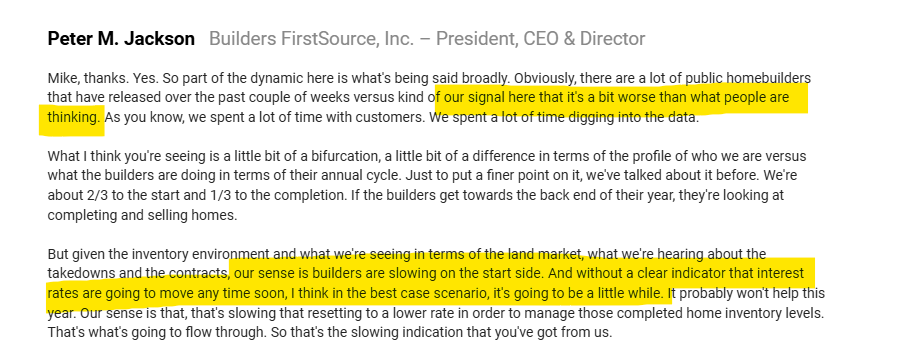
BLDR, given its position in the supply chain, should be a leading indicator for single family starts, implying starts are going to slow more soon. It seems that many of the public builder’s positive results may be more burning off starts & lots from earlier in the year vs new starts, implying Q3/Q4 might start to look uglier.
It really feels like the housing market is starting to slow significantly, and I worry things could break. But I am hopeful the downturn will be more regional as we have seen in many past recessions, likely concentrated in sunbelt markets like TX and FL.
The hotel market continues to be ‘meh’, held back by economic uncertainty and reduced foreign visitation. Revpar growth has been ~flat, but ebitda is slightly negative due to continued margin erosion.
Interestingly, group growth has petered out, frankly way earlier than I thought. This is a miss on my end and is unfortunate for Park’s group centric portfolio. That said while group is no longer outperforming, it isn’t bad by any means, and encouragingly 26 looks to be set up for strength again.
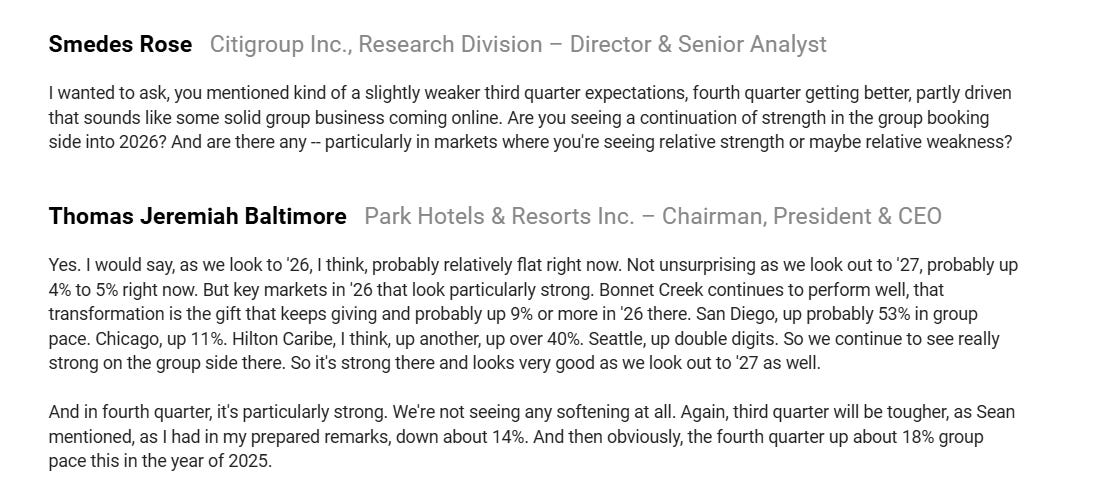
Prices have picked up a bit here from fairly depressed levels earlier in the year, so the risk/reward doesn’t look quite as good but still overall attractive due to the high yields despite mediocre operating results. Realistically though it may be awhile for a big rally, at least until fundamentals improve a bit.
Interestingly for hotels, and really all REITs, is that the fall in yields due to expectations of potential recession is driving values higher - in other words the market is assuming the changes in cap rate & financing costs will outweigh any potential declines in income. This usually doesn’t happen, but it did in the 2000s bust (for most asset classes, office got crushed), so perhaps if we have a 2000 type replay something similar will happen here10.
Retail has had the strongest year so far among asset classes, fundamentals wise, a marked contrast from the covid era weakness. The retail REITs are doing ~3-4% NOI growth, really by far the strongest performance of any REIT sector11. This continues to be driven by strong tenant demand and low supply growth, a good combination for landlords. Combined with higher going in yields and capex numbers that should come down as the redevelopment cycle winds down, and I continue to think cap rates will compress relative to other asset classes. So private market returns probably look the best among the major asset classes, at least for stabilized properties. This in turn should help retail REITs despite trading around NAV.
Interestingly tenant demand has seemingly not been impacted much by tariffs, at least not yet, despite retailers’ significant exposure here. Here is Simon’s commentary from their last earnings call.
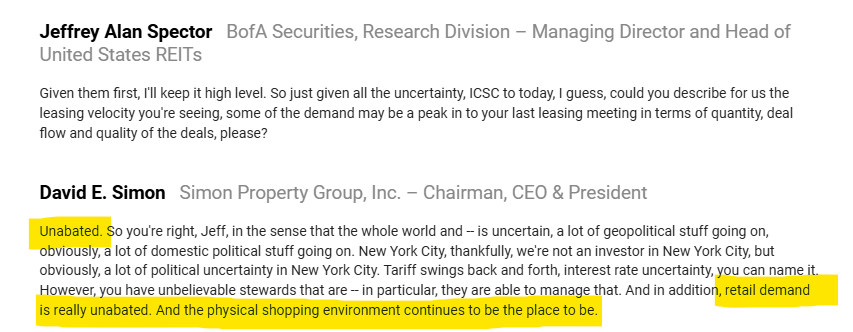
Tariffs remain to me a significant risk, but lower overall tariff rates and the recent appeals court ruling the IEEPA based tariffs are entirely illegal (which on the face of it seems correct to me) has reduced the risk somewhat. This case though will go to the supreme court, and it is difficult to handicap how they may rule, so I do think there is still meaningful tariff based risk out there for retailers. Overall it is a situation that bears watching closely, but the outlook here is much more positive than it was last quarter (albeit still worse than beginning of the year!).
The key value driver here in my view is the de minimis supply growth - in a few markets values are now getting to the point where new construction can be justified, but in most places values and rents are still safely too low to warrant new construction. This provides a nice retail value tailwind and should continue to do so for awhile longer.
The financial markets continue to be fairly open despite high rates and macro chaos. This is probably seen most easily in the nearly record low credit spreads, and in the small YoY total issuance growth we have seen.
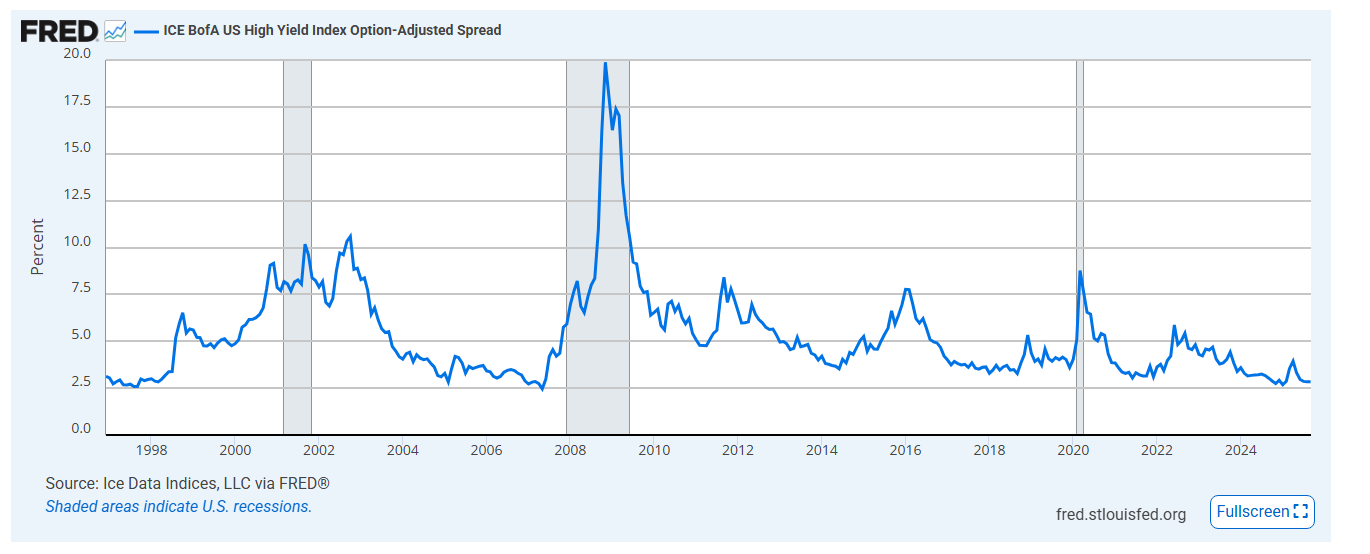
Now it is worth noting that spreads were low for an extended period of time pre GFC, as well as post, so this may well be fairly sustainable in and of itself.
Real estate specific lending feels a bit weaker than the overall corporate market, as many smaller banks still are not lending much as they digest their covid era low rate loans. But the CMBS market has largely stepped into the banking void, with first half issuance up a whopping 35% over 2024.
The real wildcard here is where inflation and interest rates go. It seemed like we were firmly on a path to lower inflation before the whole tariff debacle, now it is harder to say. Recent readings have come in a bit higher, driven by stronger goods inflation, but it is difficult to know if these are more one time in nature due to the tariffs, or if this could kick off a second wave of inflation.
Even worse is the potential for a disconnect between the Fed’s rates and inflation. Trump and his goon Bill Pulte have attempted to weaponize the federal housing agency’s information on housing loans to remove Fed governor Lisa Cook, as part of an overall attempt to force lower interest rates. Specifically, Pulte claimed Cook fraudulently claimed two homes as primary residences on mortgage applications made fairly close to one another. This charge, if true, would be pretty dubious grounds for removal (it even turns out Pulte’s own parents did something very similar!), but recent evidence has come out that it isn’t even true.
This is really ugly, nasty behavior by the Trumpistas, something you’d expect to see in a third world country. It is frankly shameful to see this in America - Pulte is an embarrassment and should resign.
The investment repercussions, beyond the erosion of rule of law (which is a really big deal), are that if Trump is successful in installing new governors / intimidating those who remain into lowering rates, we could have a situation where the short end of the curve drops quite low while the long end stays relatively high. The would likely encourage a lot of short term borrowing in order to take advantage of lower rates, and could create a volatile dangerous situation in the future. But we are not there yet - Cook is fighting her firing, and Trump has only one minion on the fed, although he will likely have another within the next 6-10 months due to an upcoming lawful appointment. At 3 of the 5 independent governors he would effectively have full control over the fed, a scary proposition12.
I worry about Trump instituting Peronist style policies in the US, with the end result being an erosion of US competitiveness & inflation / dollar devaluation. I have not been able to bring myself to switch most of my cash out of dollars but I am strongly considering doing so, along with potential international equity diversification13.
Overall it feels like there are many cross winds buffeting the economy, but nothing has capsized the boat yet. However the recent slowdown in jobs is very concerning & we may be close to reaching a tipping point on a downturn. And yet we have all time highs in the market, memestocks, crypto frauds - heck Chamath even launched another SPAC. It feels like a dangerous combination of froth built on weakening fundamentals.
Commercial real estate continues to muddle along in its recovery from the recent pricing slump, with performance highly variable across asset class and geography. I am hopeful that if we have a downturn the impact on CRE will be mitigated by the decline in rates, which should hopefully offset some of the income losses. But it is hard to say, and overall I am as defensively positioned as I have ever been, with a large cash position and a good sized short book as well. We will see if that proves wise or not. As always, thanks for reading.
June was further revised down in the August release, and July was revised up, giving us negative growth in June.
Obviously biotech research and its ilk are proper economic productivity drivers, but the vast majority of health services jobs are things like elder care workers, nurses, doctors etc.
The Indeed data seems to lead the official government / fed data which are still much higher, so its sharp recent deterioration is something to watch.
Specifically what Altman said was “When bubbles happen, smart people get overexcited about a kernel of truth,” “Are we in a phase where investors as a whole are overexcited about AI? My opinion is yes. Is AI the most important thing to happen in a very long time? My opinion is also yes”. For what its worth I agree that AI is both a bubble and that it will be a big deal long term… just like 2000.
A key question here is what share of capex is training vs inference. This is really hard to tell honestly, but certain firms at least I can relatively confidently say are highly training driven. These being Meta and Grok, as neither has a huge number of users for their LLMs. The question is what share of OAI or Google’s spend is training vs inference. But we can infer a bit on this by the scale of Meta and Grok’s spend - Grok is about to spend ~$25 billion on its next training cluster it seems, so its probably safe to assume that OAI, Google, and Meta each are spending something similar on the next generation of training, to say nothing of all the other model providers or customizers out there. That would put us at ~25% of capex for training just for those 4 model providers alone, and there are many more model providers out there.
Another data point is Nvidia shared that training was ~60% of revenues 2 years ago - inference’s share has likely grown since then, so as a guess one might say conservatively inference is now 60%, and training 40%, which would mean training is ~$160b of the current $400 B run rate. Even if inference continues strong growth (which it probably will), a lack of need for more training means those training clusters likely transition to inference, effectively flooding that market with additional supply. GPU spot pricing is another way to look at inference demand, at least as it relates to GPU supply. H100 rental prices are down ~-9.28% from end of May to today, which is over a -30% rate of annualized decline! And this is before the new Blackwell clusters are really fully online. So overall it seems that spot supply is well ahead of demand, even before the newest, and largest, wave of additional supply hits the market. This feels very much like a recipe for oversupply - hence my overall confidence AI capex should slow dramatically given some of the demand growth is likely to pull back here soon.
Depending on how long it takes for the current round of cash to get spent this may be more like mid 2026. The main point is that there probably won’t be another major up-round from here.
The most likely reason is that Plymouth did a JV with Sixth Street back in the fall of 2024 where they sold a portfolio to Sixth Street, and also gave Sixth warrants to buy stock in the mid $20s (close to the stock price at that time), and also got a bit of preferred equity from Sixth. The market reacted very negatively after this, and the stock has been depressed at some level since then. My view is that the warrants weren’t great, but given their strike price relative to NAV weren’t that bad and just represented another way for the company to grow their capital base.
Not to say that industrial values couldn’t also begin to struggle, but currently the fundamentals there are better than office or hotel.
Specifically the problem really isn’t so much that office developers are any more cowboy than other kinds (basically all developers are wildcatters at heart), but that any given office development has the potential to be much larger relative to the existing supply relative to say multifamily or industrial. So it only takes a few fools to overbuild office.
Hotel REITs did pretty well right as the recession began, but fell off a cliff after 9/11 and the fall off in travel right afterwards.
Technically industrial is seeing similar growth but this is catchup mark to market from the huge covid spike - actual rents and occupancies are falling in most markets, so this performance will soften soon.
As while there are 7 regional governors, the 5 independents can remove those 7. So effectively 3/5 means full control.
Partially because most other nations are also in a bad situation vis a vis debt and government spending.