A common refrain I see today is that the market today can’t be in a bubble because the multiples are too low. Setting aside the many examples of insane multiples1 we do have, I believe these investors are fundamentally misunderstanding the nature of the current boom.
That is because these investors are applying their old heuristics for the tech business built over the last 30 years to a new market dynamic which has evolved into something quite different.
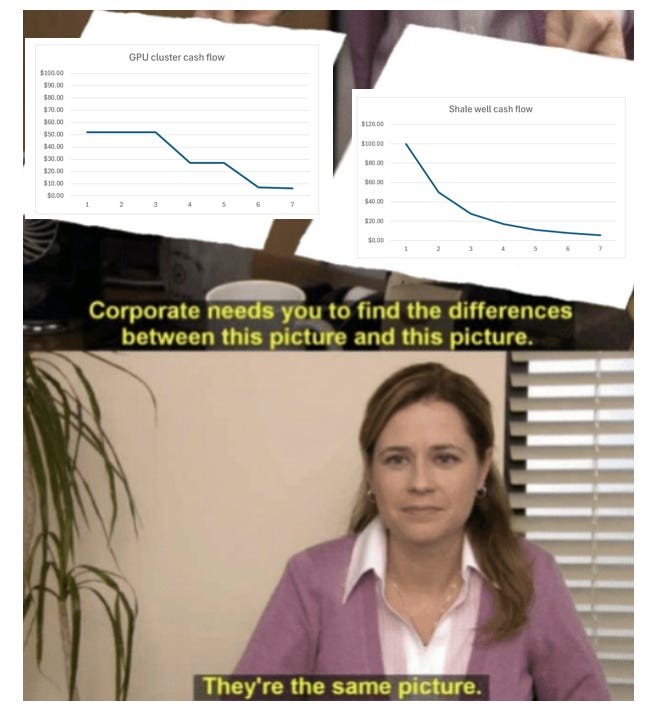
What has happened with AI is that tech (or at least the LLM part), has moved from a zero marginal cost business to a business with marginal costs. And equally importantly, it has become a business reliant upon large investments in physical infrastructure with relatively short useful lives & declining cash flows over time2. This is completely and fundamentally different from the prior tech market structure.
What it is very similar to is the energy business3. Oil & gas requires large up front investments in projects which produce declining cash flows over time, requiring constant reinvestment to generate new earnings & evaluation of investment returns on capex spend. Unfortunately for tech investors, this is the new reality for their business as well - they just don’t know it yet.4
GPU vs shale well cash flows over time.5
There are all kinds of issues with this business structure, of which energy investors are painfully aware & which tech investors will soon be learning all about.
As always, nothing here is investment advice. Please see my general disclaimer here.
Asset heavy businesses are inherently prone to boom & bust cycles, as multi year construction timelines to deliver new supply means that supply and demand can become very mismatched, both to the positive and the negative.
This is doubly true for businesses with assets that have declining cash flow curves - operators will charge whatever they can get to maximize revenues during the relatively short peak earnings window of their assets. Thus the only floor on price is the actual marginal operating cost, which is very low for both LLMs & oil.
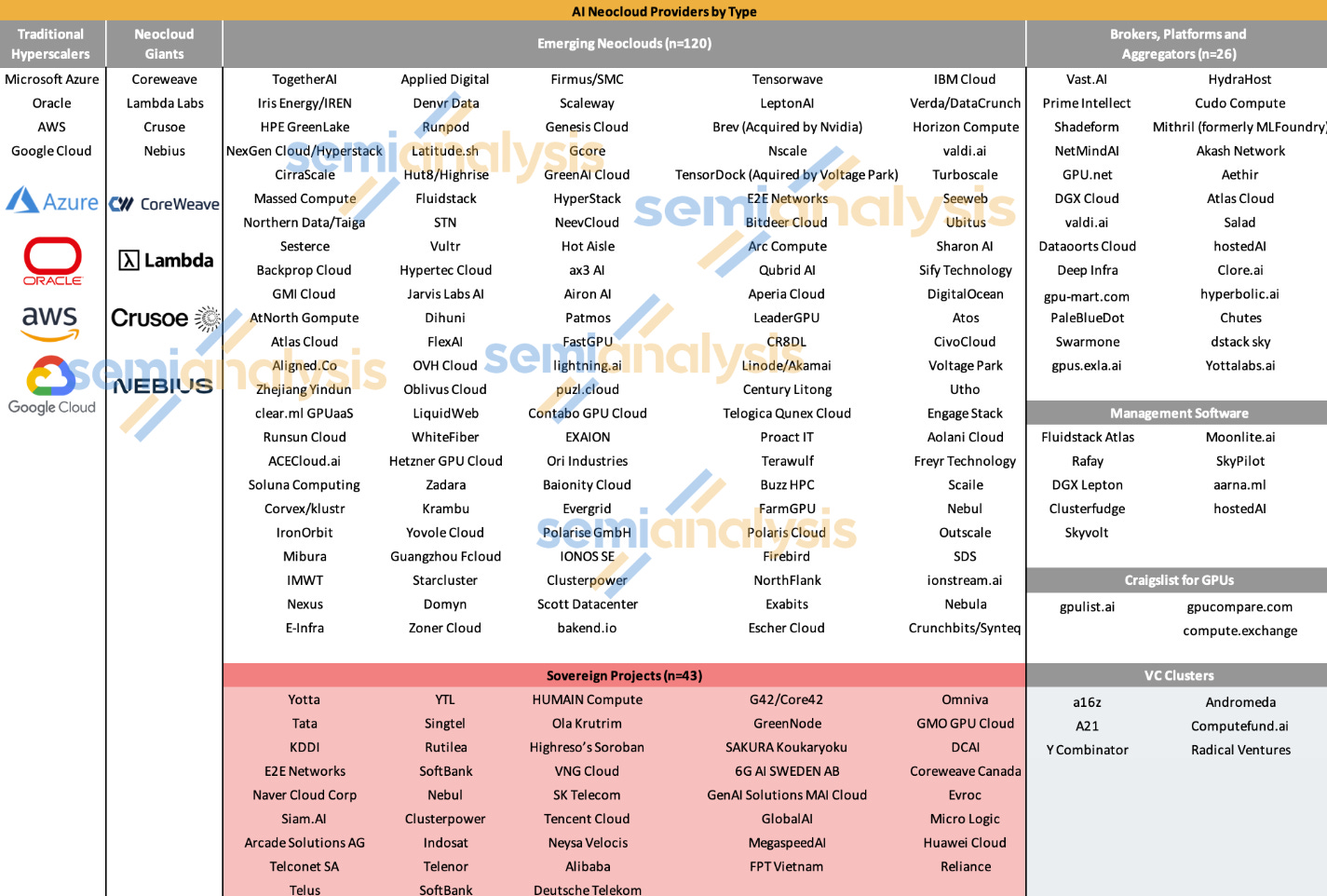
The final cherry on top is that by their very nature, commodity asset-heavy business also invite significant competition. It is fairly easy to start up a new entrant if you have the money. This can be seen in all the small oil & gas wildcatters, and now in AI we see it in the massive proliferation in AI ‘neoclouds’.
The AI cloud computing business is transitioning from an oligopoly with just 3 major players, into something more like the energy business with several ‘majors’, and hordes of smaller players as well. Below is a table from industry research provider Semi Analysis (https://semianalysis.com) detailing the new AI neocloud universe.
What oligopoly?
This chart is extremely bad news for the economics of the GPU cloud business. And it in fact understates the scope of competition! This is because many of the large LLM research firms are also building out their own in house cloud capacity - most notably xAI and Meta, but OpenAI and Anthropic are moving in this direction too. And these are some of the largest GPU clusters out there. I believe it is almost inevitable these firms will begin to rent out their GPUs to third parties, as their internal demand loads are insufficient to actually monetize the enormous investment they made. Indeed Zuckerberg hinted at this recently, and there are rumors that xAI is already staffing up a salesforce.
Long term this dynamic may even erode the big tech oligopoly on cloud computing generally. Just as the hyperscalers found it relatively easy to move from general cloud computing to AI cloud computing, I believe the largest and most sophisticated neoclouds will find it relatively easy to move into the traditional cloud business. This probably won’t occur until the next business cycle, as these firms begin to look for new revenue sources outside of their brutally competitive core business, but it may occur sooner. This could then become a drag on investment returns in the core cloud business for AWS, Microsoft and Google.
So if all of this is accurate, what might that mean for investors?
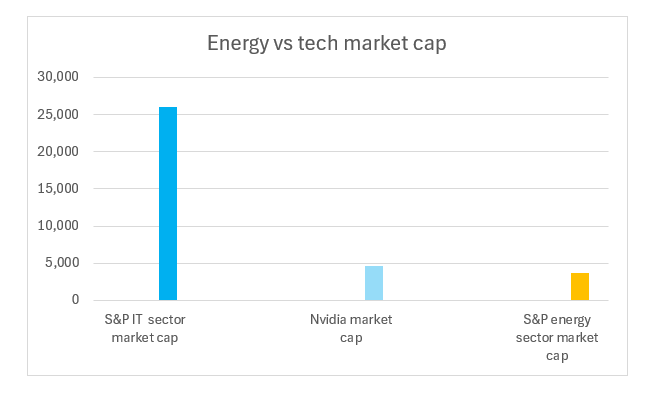
Some basic comparisons between the energy and the tech sector may be helpful. Below is a chart showing the market cap of the S&P 500 IT sector vs the entire energy sector - as you can see, IT is massively larger.
Nvidia alone is greater than the entire market cap of the energy sector!
Nvidia has fallen a little bit since I made this chart but you get the picture.
However, when we look at relative revenues of the two sectors, things are much more even.
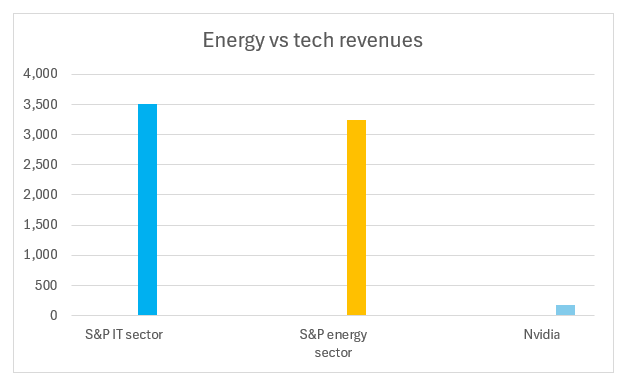
Why the big difference? Relative profit margin, and the multiple assigned to said profits (a function of tech’s strong recent earnings growth). These charts obviously have very troubling implications for generative AI investors.
One of the key problems is that a multiple isn’t even the proper metric to use for cash flowing short lived assets. You can’t just slap a multiple on something which only generates meaningful cash for 5-7 years - instead what is needed is a project level IRR. Energy investors know this, and that is why you only see sector tourists talk about multiples when it comes to oil & gas producers6. Tech investors will learn, eventually.
I believe that even in a best case scenario, the generative AI GPU business looks something like the oil & gas industry, in that even if it generate significant revenues & societal value, profits and high investor returns will prove much more elusive.7
So we may find it informative to look back at the many oil booms & busts as something of a parallel to our current situation. The recent shale boom I believe may prove particularly informative given the analogous steep revenue decline curves.
There are obviously many differences here8. The most notable is that the oil business was very large and established during the prior boom, and that the relative demand / supply mismatches were fairly small. Overall oil production grew only from ~4,000 Mtoe (million tons of oil equivalent), in 2007 to something like ~4,500 by 2017, a mere 12.5% total increase over 10 years. And this relatively small supply growth caused oil prices to fall from over $100/ barrel to as low as $33 in 2016.
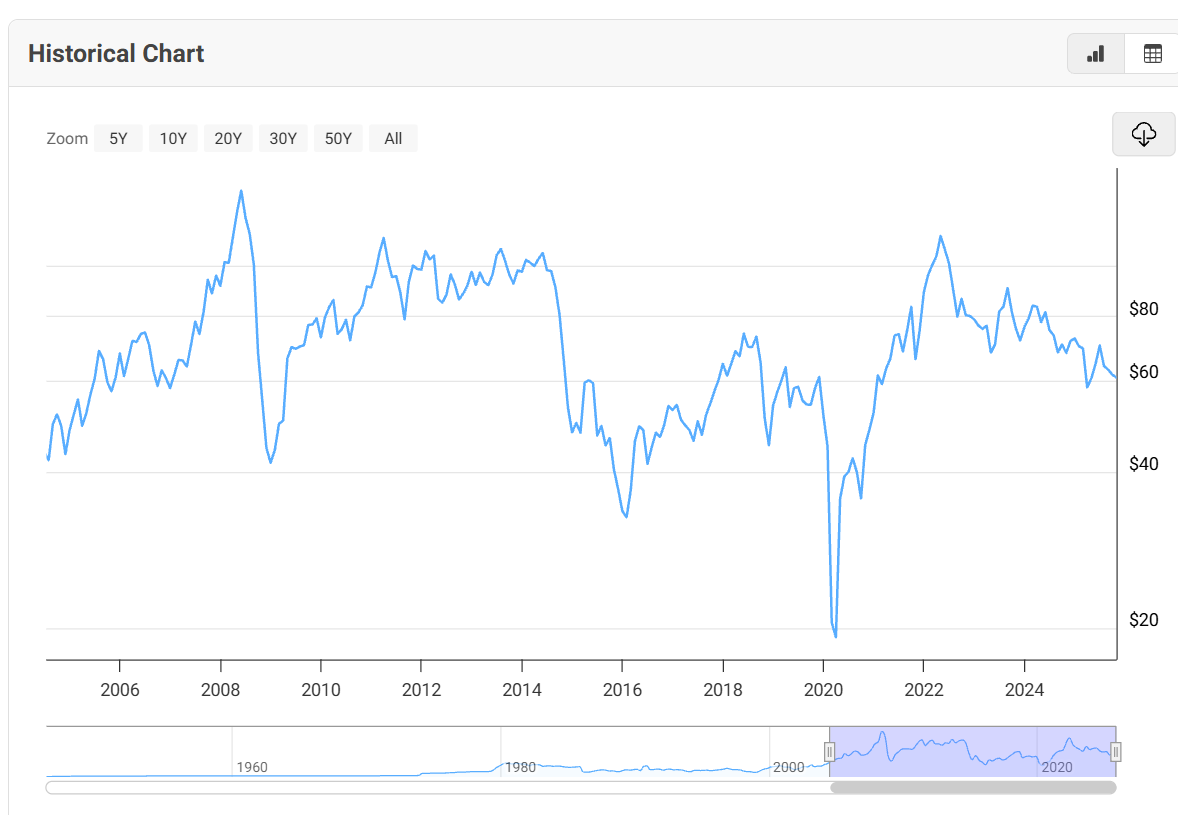
Once you adjust for the ~30% inflation we have seen, oil prices today are actually much lower than they were pre-covid.
Meanwhile datacenter supply in terms of MW of power is up ~15%/year over the last few years, and is projected to triple from here by 2030 according to Cushman & Wakefield’s industry report from May (and the number is almost certainly much higher now than May given the huge slate of announced deals).
Given the improvements in chips and some algorithmic improvements as well, the actual token production is up massively relative to the simple power figures. Thus far, demand growth has if anything exceeded supply. The issue is that given supply is going to triple9 from a power perspective alone, if demand doesn’t keep up the supply/demand mismatch could be enormous. Another way to look at this is - given chip and algorithmic/model improvements, the ~15% annualized datacenter power supply growth we have seen has been roughly sufficient to meet demand. We are entering an era of more like ~25%/yr power supply growth, so if we hold chip & algo gains constant, demand actually would have to accelerate from today’s already strong levels to simply meet the new supply.
Can you imagine how far chip prices will fall if we have a 15% supply/ demand mismatch, let alone a 25% one or even higher? Conceivably from an end token perspective if demand slows down and we get some big algorithmic efficiency gains you could see a scenario where supply outstrips demand several times over within a few years.10
The big issue we have is that no one knows how big demand for generative AI will be, and many in the tech world have convinced themselves that artificial general intelligence is nigh and that these investments are existential.
The problem is that if AGI doesn’t come soon, these investments will have to pay for themselves the boring old fashioned way, with ads, user subscriptions and business use cases. At current pace of spending we will be approaching $1 trillion in total capex soon, maybe as soon as the end of 2026. At a 25% margin, that capex would require $4 trillion in revenues to just break even, and $8 trillion to earn a reasonable return!
Unfortunately, we are already seeing some signs of a slowdown in end AI demand. If this data is accurate, OAI’s traffic is essentially flat since May. And the industry overall has stalled out since the mid September bump, likely caused by return to school.11
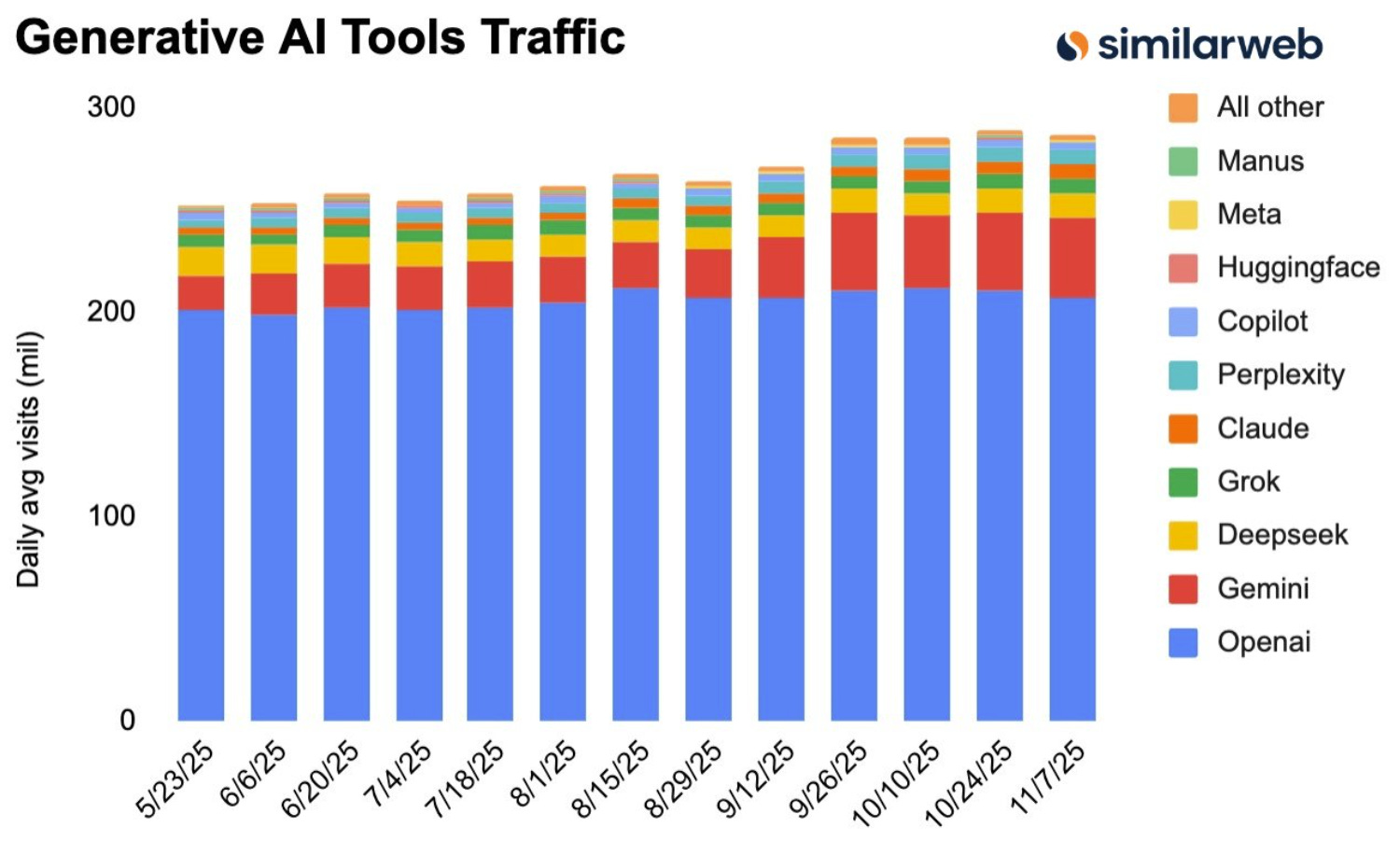
So LLMs are potentially already stalling out in traffic, and we have a monstrous supply wave still incoming. This could get really ugly.
There are some important caveats here - daily traffic is not the same as model usage, nor is it equivalent to monetization. AI providers are in the early days of monetizing their users, so revenues can likely climb significantly just by getting additional revenue from the existing user base (ads for example are fairly low hanging fruit). Of course demand could also pick back up - growth has slowed several times in the past, but accelerated again with big new model releases. The big problem for OAI is that they just released their latest models (GPT 5 and now 5.1), and the release didn’t do anything for overall traffic.
Unfortunately for OAI, daily time spent also appears to be down per recent Apptopia data shared by crunch base (full story here).
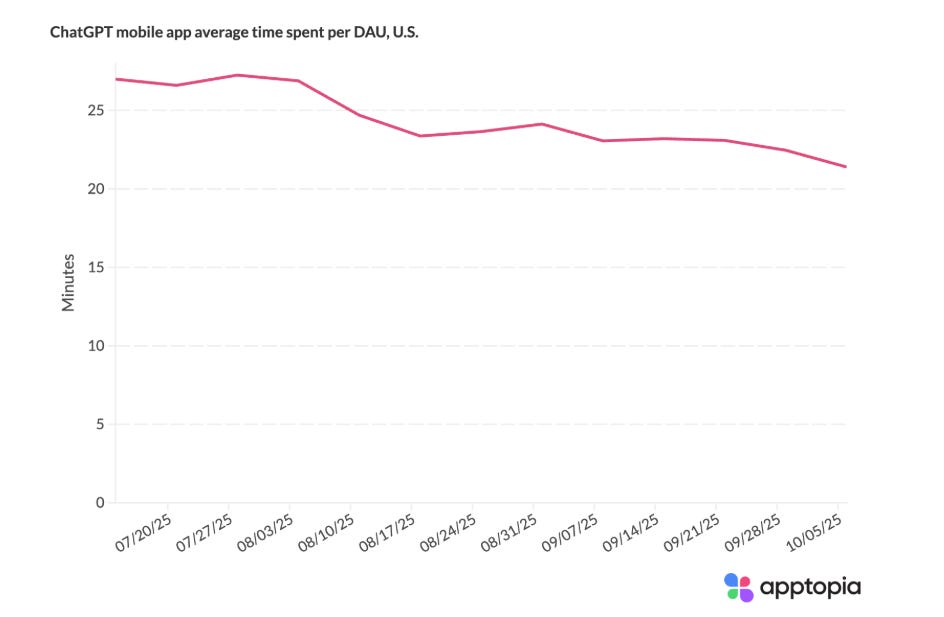
Apptopia is an investor oriented mobile app data firm.12
And all of this data is before Gemini 3’s release, which likely has taken further share from OAI. It may also have grown overall industry usage, though that remains to be seen.
The one area that seems to still be growing strongly is what I believe to be generative AI’s best use case by far, which is coding. This can be seen in Cursor’s recent fundraise which notes ARR is now over $1 billion, over double the last reported figures in early June. LLMs also continue to deliver improvements in coding quality which bodes well for continued growth here.
I personally doubt that coding alone is going to be able to drive the monster increases in revenues the LLM providers are going to need to earn a return on all of the capital being invested. The capex numbers are simply too large such that even revenue figures that would be considered wildly successful by any other measure would fall incredible short - by my estimates by 2027, if current spending pace continues, $2 trillion in revenues per year could be needed to earn a ~cost of capital return on the capital investment13. That is frankly patently absurd, the only thing that can even get you close is AGI.
While I am very confident that this shift has occurred, I am less confident of when the whole thing blows up and becomes obvious. My guess is sometime from now to mid 2026 as that is when the current round of build outs should start to wrap up, but if LLM progress continues rapidly it may push out farther14. Already though, two of the major GPU buyers, Meta and xAI, seem to have almost zero return on their massive investments, and it is hard to imagine them stepping those investments up to the next tier required by an additional level of scaling. OAI and xAI fundraising will be the canary in the coal mine - once they miss on a raise the entire thing is over. I suspect Zuck breaks last given his history of awful capital investment - this is the guy who spent tens of billions to create something lower quality than Second Life, a mid 2000s MMO that was probably developed for sub $20 million originally (and indeed Zuck is still spending on the metaverse!).
The problem for the model makers is that they are stuck in a brutal competitive cycle - because switching costs are almost as low as I’ve ever seen, if you fall behind just slightly you can lose customers en masse. This means it is quite likely that most if not all of the major model providers will invest all the capital for nothing, and be left attempting to rent out the GPUs to others to salvage their investments. I suspect the last person standing will be Google, as their TPU’s give them a fundamental cost advantage over the other players.15
As always, thanks for reading. You can subscribe below if you find this interesting. I also want to emphasize again that I do believe LLMs are a very useful technology (which will continue to improve), and will generate a lot of value for society, and associated revenues. But I also believe the current AI capex wave is going to end very poorly, and the overall business model of the LLM space does not look very attractive from an investor’s perspective at the GPU and model layer. I do think software built using AI is likely to be very attractive though - the winners here will be the consumer, and businesses which can establish real moats and switching costs for their users.
Palantir, quantum, nuclear, crypto to name a few. Although we have seen the beginnings of a meaningful sell off in these areas finally.
This is of course what is responsible for most of said marginal costs - the actual literal short term marginal cost is fairly low for both pumping oil and running GPUs, most of the long term marginal cost is the capital investment required to bring a project online & the required returns thereon.
You could also draw parallels with other capital intensive business and build outs such are railroads or telecom, but the key difference is the relative useful life of the investment. Railroad tracks last for decades, and telecom cabling has a long useful life as well. So energy is the cleanest comparison given the short useful lifespan of GPUs, albeit still imperfect.
I do wonder whether some execs at large AI firms are aware of this, at least subconsciously. The move of many AI firms into the GPU hosting side of the business seems rather strange at first - why move into an undifferentiated commodity capital intensive business? But there is a hidden silver lining here, as by raising huge sums and investing it in capital these firms create a floor on value - so if say OpenAI’s models are undercut by cheap opensource competition (which frankly looks fairly likely), they can fall back on the cloud rental business. This doesn’t do the investors who financed said investment much good, but it may preserve the company and the jobs of said execs.
If you are curious I used A100 prices (2 generations prior Nvidia chips) for the GPU chart based on 2020 vs today, and shale is based on a roughly typical decline curve. A100 had 4 years between generation releases, but Nvidia has moved up their cycle so I adjusted prices with a year 3 drop to account for the quicker current release cycle. I also used a pretty conservative starting price for the A100s - I have seen estimates as high as $4/hour from old AWS release docs, but have seen others quoting $2.4. I used the $2.4 as a starting point to be conservative to calculate the estimated 5 yr decline - it would be way worse if $4 really was the original pricing. Another point worth noting is that these charts are meant to be illustrative based on ‘constant’ pricing for compute / oil. Should prices rise the cash curve looks different, but the same is also true if prices fall.
What you need is a DCF. One for the existing drilled wells, and another for the undrilled potential. Energy uses PV-10 for the undrilled assets, or present value of undrilled reserves at a 10% DCF. Existing wells depends on the remaining useful life and so varies by well type & relative age. Obviously there is no PV-10 equivalent for generative AI.
The analogy breaks down somewhat in that all this capex enables a new technology which is still capable of producing high margin software type businesses. So we likely we still see some very valuable traditional tech type companies in the generative AI space, but they won’t be the ones involved in the GPU capex game.
A big one is also what each industry enables downstream. Oil & gas enabled essentially the entire transportation industry among other things, which is pretty enormous. Also heating, energy generation, and new materials to name a few others. AI opens up new areas to software development, some of which are pretty cool. But if I had to guess I’d say the impact ends up being smaller in terms of societal value as compared to energy.
Or much more from a token perspective, again depending on how you look at chip improvements and further potential algorithmic efficiency gains.
And of course this doesn’t even contemplate the possibility that GPUs may not even be the ultimate winning technology! Google uses TPUs which are well suited for inference, and Google’s latest model, Gemini 3, was apparently also only trained on TPUs. This is another huge risk to the monster capex spend of every player, excepting that of Google.
AI is relatively new so it is hard to be confident of seasonal demand trends, but there appears to be fairly good evidence that student demand is very large and runs seasonally with the school year.
I can’t vouch for the accuracy of their data, so it should be taken with a large grain of salt. But they appear to have built a fairly decent mousetrap on usage data by reverse engineering Google and Apple app store ranking data, which incorporates usage data, & cross referencing this with app data they do have access to in order to infer usage approximate figures.
I had previously given some lower estimates but upon further reflection I think I was overly generous in my margin assumptions - I had given the LLM providers the benefit of an AWS type margin ex depreciation. The problem is the model providers have to deal with what is an AWS like compute rental business, and then they also have to build models & sell / distribute them to customers. Thus my old margin estimates were far too generous - it is hard to know what exactly the proper margin is, but at ~25% you get more like $2 trillion in annual revenues to earn a 2x return on the capex, assuming $1 trillion in total capex by 2027. And at current spending pace that would of course go even higher as time went on.
Indeed at the margin NVDA’s large investments in its customers may also serve to push out the crash a bit. But the market is pretty good a sniffing out inflection points, so we shall see.
The open source Chinese models will also do well I think given their massively smaller costs & rapid following of the leading edge. Speaking of China - another bear case for all this AI capex I haven’t even gotten in to is if the GPU decline curves accelerate due to China eventually cracking the chip business. Huawei has made tremendous progress, and China has essentially made it a state mandate to break reliance on Nvidia chips. It is difficult for me to handicap the odds of this happening but it seems reasonably likely that within 5 years Huawei could be competitive with Nvidia quality wise and at a much much lower price. This would of course crush the value of prior chip investments.