
Dear friends, I am writing to give my year end update. Please view our evergreen disclaimer here, I may have positions in stocks mentioned here, and none of this is investing advice
First as always, the returns. We unfortunately had a poor year, with returns basically flat at an .8% net return for the year. This compares to ~17.08% for the S&P, and 2.87% for the REIT index. Longer term we are still outperforming, at 190.15% vs 61.27% for the REIT index and 155.29% for the S&P, although the S&P gap is narrowing1. 2026 has been off to a better start but the market is obviously volatile.
The drivers of the weakness are broadly two fold. The first is we are very defensively positioned with a good sized short book - these positions obviously did not take off given the continued euphoria in the markets (although they are looking better today!).2 The second is that my other investments are primarily value oriented, and these frankly performed quite poorly.
The flip side of this is that I actually feel very good about our positioning currently, and think there is a lot of value & potential upside in the portfolio.
Our new largest position, Vail Resorts, is probably the best example of this.
Whistler, one of Vail’s major resorts.
I started buying in February, when the stock was in the upper $150s. Unfortunately the stock is now trading at $133 (which I think is an incredible opportunity on the flip side) - I bought more as it fell, but our cost basis is around ~$148, so we are still down a decent bit here. Vail deserves it own write up entirely, but the quick thesis on it is that Vail owns irreplaceable assets with very limited new competition, and is cheap on almost any metric you want to use. For context the first new ski resort in 30 years opened adjacent to Deer Valley, and it took 10 years, usage of a government permitting loophole, and cost ~$1.5 billion to build3. Or you could buy Vail’s 15 major resorts (and a host of minor ones) for just over $7B in EV today. The big risk is snowfall - the current weak snow year is likely one of the main reasons the stock has fallen back down. But snowfall trends are generally up actually over the last several years, and I believe the risk to be manageable (and the epic pass helps smooth out revenues significantly), although it does bring a bit of random year to year variance with it.
Alexandria is another - in attempting to catch a falling knife, I didn’t quite time the bottom right, but I still believe we have a very attractive basis, and the stock looks even better today. ARE is the largest life sciences landlord in the US - this sector has struggled with a double whammy of a biotech bust and big oversupply (triple if you want to count WFH, though lab space wasn’t hit quite as hard as normal office in this regard). I believe the stock is currently oversold - their portfolio is by far the highest quality with some truly top tier assets. The bio sector is coming back, and I believe strongly in its long term growth. In fact it began to recover somewhat in 2025, just take a look at the XBI.
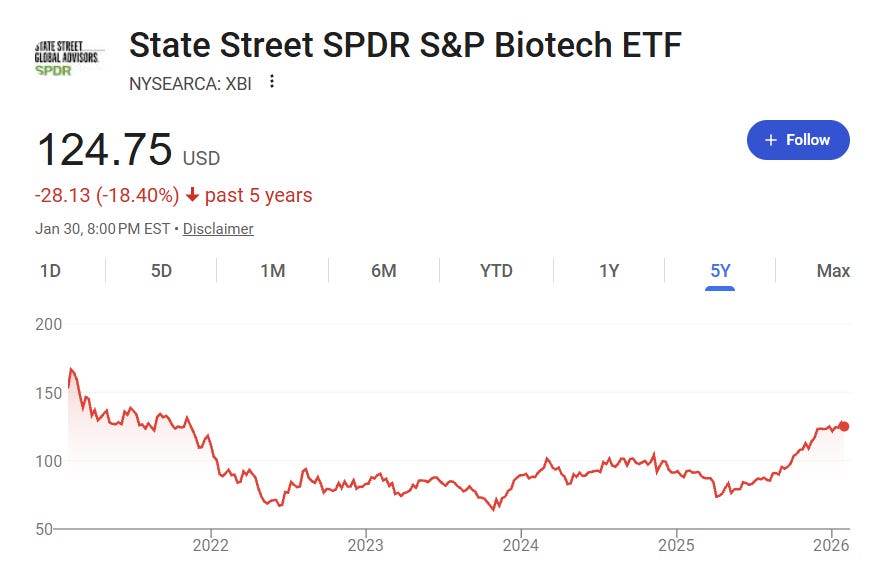
The stock market is a leading indicator, real estate leasing is very lagging (indeed it really just started hitting ARE’s results in 2025 nearly 3 years after the collapse!). If the bio rally continues we should see a turnaround in bio leasing fundamentals in the next year or two, although ARE will likely still see hefty NOI declines from here given move outs etc. ARE is trading at an ~10%+ cap rate today, which I believe falls to low 9s on future NOI declines - too cheap given the strong lease terms & asset quality (top life science assets were solidly among the lowest cap rates in CRE pre-bust).
Not a whole lot has changed overall since my last letter, so I won’t spend too much time on this subject. Broadly my position remains the same - AI capex is at unsustainable levels and it won’t be possible to generate economic returns on it unless we have true AGI imminently. The rest of the economy continues to be soft - unemployment continues to tick up, real estate is soft, and job growth has slowed to almost nothing. So I still believe if the AI bubble bursts, it could get rough for the rest of the economy.
I remain quite confident the current tack will not yield AGI anytime soon, although it has continued to improve, and I expect it to continue! Again the best use case is coding, and LLMs have continued to improve here4. The markets have finally woken up to the consequences of this for the software space - if its easier to build software, all else equal that would certainly be negative for incumbent software firms. Unfortunately the software firm I am short, Palantir, has surprisingly not fallen very much despite being massively more highly valued than any other software firm. Perhaps I should have taken a broader basket, but I remain convinced that Palantir has a lot of potential downside given its rich valuation. And it is especially nice as a hedge against a downturn.
Interestingly on the model progress front - we have reached what seems to be the first time that the current state of the art models are not universally better than previous models. This indicates to me we may be getting pretty close to the potential performance frontier of what LLMs can do. And the reason I can state this confidently is that as I have hinted, I am working on an AI project in the finance space (which we will be launching quite soon!), and Gemini 3 is, for several of our use cases, inferior to Gemini 2.5. Overall G3 is still better when looking at a range of use cases (I use it all the time for quick high level research or questions), but we may be getting close to the point where returns are diminishing.5 And that has significant consequences - I continue to believe the bubble will burst either when model progress slows, or revenue growth slows. So we may be approaching A (although I frankly underestimated how far RL could take us so I could be wrong here too!).
But speaking of revenue growth - we may also be getting close to things slowing down here too. OpenAI’s Q4 traffic showed extremely weak growth per SimilarWeb’s numbers below.
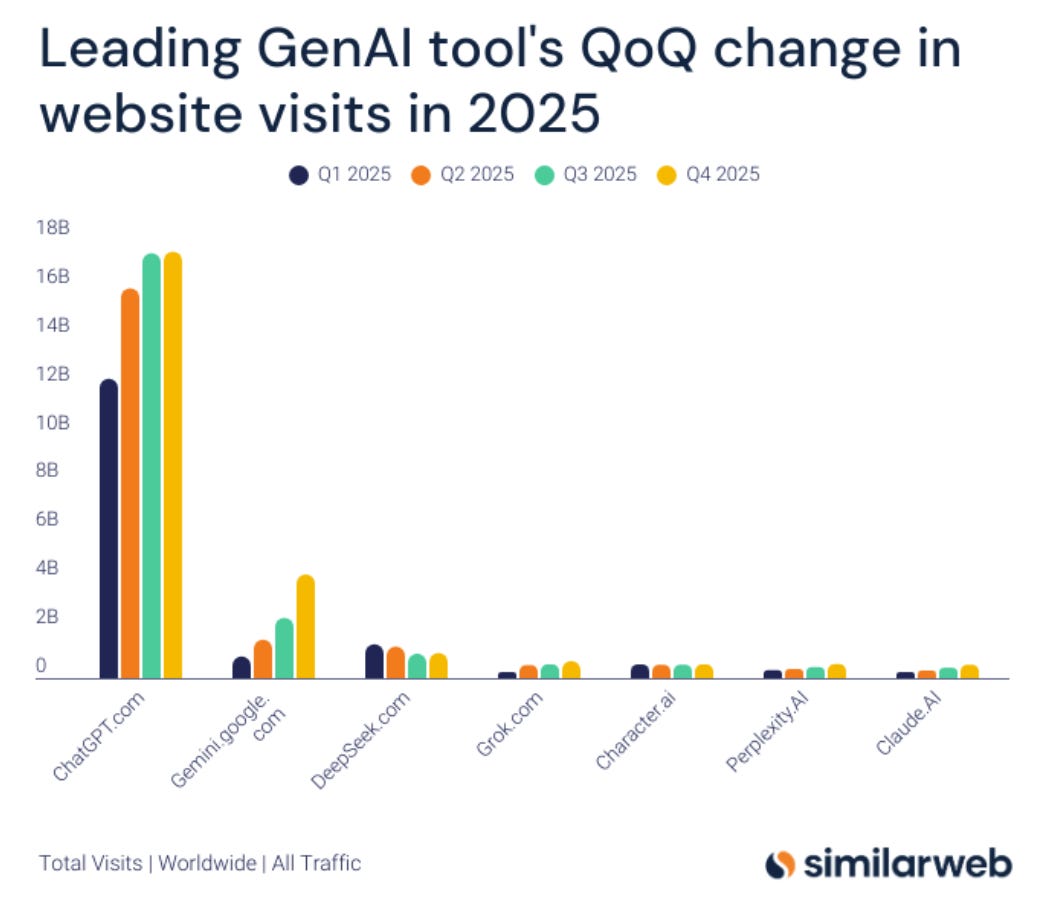
OpenAI bulls would note that the business has seasonality to it and that Q4 is always weak (this seems to be due to the large student usage, which IMO is also bearish but a whole other can of worms). The problem with this view is that Gemini had a massive Q4, and Claude also continued to grow strongly. So its a bit harder to argue its seasonality when the other competitors don’t seem to be affected in a similar way. Even worse - OAI’s traffic has been anemic since basically May of 2025, whereas in from May to November 2024 OAI saw ~50% increase in traffic.
Here is data from SimilarWeb I cobbled together using Gemini (fun note I gave this to both Gemini and GPT, Gemini did this in about 30 seconds, & GPT took 10 minutes. IMO this huge speed gap is why people are switching to Gemini en masse).
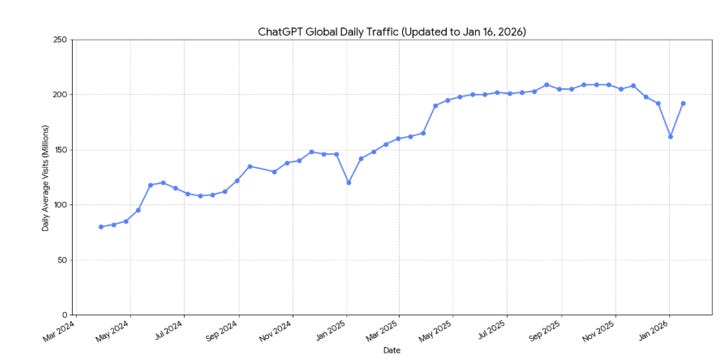
Data assembled from 4 different charts SimilarWeb published in their ongoing Global AI Tracker Series. They have nice data, check out their website here or twitter here
As you can see, GPT traffic appears to be stalling out and even declining, which would explain why it seems like OAI is flailing about looking for a new hit product or way to make revenue. This can be seen in their flip flop from ‘never ads’, to recently announcing they are going to put ads in their platform. And the Sora app feels like a desperate attempt to revitalize user growth (which seems mostly to have failed).6
Interesting mobile data vendors are showing a spike in mobile traffic in the new year for OAI - my best guess is this reflects growing usage in emerging markets which are much more mobile first than developed. OAI has been aggressively offering free trials and partnerships through other apps in many emerging markets, which I suspect helped drive these mobile figures. Obviously this is still beneficial to OAI but the revenue per user in these countries is far lower than the developed markets, so this kind of growth isn’t nearly as valuable.
We will see what happens over the next few months, but barring a big change it looks like OAI’s days of heady affluent user growth are behind it. And that is going to make it much harder to increase revenues at the forecasted rates.7
Needless to say - if OAI’s growth slows down even a little that would have massive repercussions for the AI space as a whole. If you want to assume 10x sales is a reasonable multiple (which I would argue its not, due to the capital intensive and commodity nature of the business), then to justify its rumored new ~$800B valuation8, OAI needs to quadruple its revenues from its current ~$20B run rate. To get there in say 4 years would require a 40%+ annual revenue growth rate. It also requires acceleration in terms of absolute dollars of revenue growth - again something that is very hard to do if your core user growth is slowing or even declining.
So all this to say - things are mostly playing out thus far as I expected. I am not fully confident the AI hype will burst in 2026, but I think almost certainly by 2027 we will see a big slowdown9. And I continue to think long term AI will generate a ton of revenue and economic value... just not enough to justify the current wave of investments, and I’m also not sure how much of the value will actually accrue to the current largest players. Its hard to see things working out for OAI et al when Chinese firms are able to deliver open source models that are ~97% as good for 10% of the cost. And as models get better that 3% difference looks less and less meaningful. The best way to describe whats going on in my view is a mix of a tech bubble with a capex/commodity bubble. The problem with this is that no tech investor has any experience with capital intensive commodity businesses, so I suspect their previous heuristics are going to fail them very badly.
I think the main way I’m wrong here is if we do see continued rapid progress for several more years, to the point people can rationalize investments in the name of achieving AGI. But it feels like the narrative has already moved away from that, with many of the top AI researchers saying LLMs are a dead end on that road, and my own first hand intensive usage also says otherwise. As relates to my investment portfolio though - I don’t have much in the way of direct AI shorts, so I don’t necessarily think this is a huge disaster for my investments if I’m wrong. As basically it just means the economy continues to grow nicely, which is good for most investments! Our short book is full of things that are specifically overvalued and would hopefully still come down even in a growth scenario.10 And just to reiterate - the reason I spend so much time on this subject is it appears to be by far the biggest & most important economic driver right now, especially given the weakness pretty much everywhere else. So if the AI bubble bursts I fear it could have significant repercussions elsewhere.
As some of you may have noticed, there was no CRE REIT commentary last quarter. Unfortunately I was just too busy to write an article for Q3 - hopefully I can do more writing in this area in 2026. But I’ll try to cover bits and pieces that caught my eye here.
Broadly, I would say we have seen little in the way of major changes in the CRE markets from my previous commentary, so frankly there isn’t all that much to write about. Apartments remain soft due to oversupply and weaker than expected demand in the sunbelt. Industrial has picked up a little and continues to improve, although it still remains a bit soft overall (PLD had pretty positive Q4 earnings & commentary & noted that overall vacancy has begun to decline). Office is weak outside of NYC, but has continued to improve a bit especially in class A. Retail continues to do well, primarily due to the lack of new supply. Hospitality is soft - frankly a bit softer than I expected, but the consumer seems to be weakening relative to the rest of the economy. There have been several good sized REIT take privates and liquidations, and I expect this trend to continue into 2026 so long as the economy holds it. It is by far the best way for big players like BX to deploy capital in the CRE space.
We have some big updates to the portfolio beyond what I noted in the intro, which hopefully I will be able to spend a bit more time diving into in more depth in the future. One of those is that I have been ramping up non CRE investments, an interesting example of which is uniQure. This is a biotech stock which has a potential groundbreaking gene therapy for Huntington’s disease called AMT-130. They presented their initial results back in September which showed disease progression slowing by ~75% 3 years after treatment, and the stock rocketed up to as high as $70/share.11 In a twist, the FDA came in 2 months later and rescinded their previous agreement to use an external matched control group to compare Qure’s treatment to, which has caused the stock to crash down to its current price of ~$23/share. What is interesting here to me is that very few argue that the drug isn’t effective - the worst case scenario seems to be that the FDA makes Qure do a randomized phase 3 control study, which they have been trying to skip based on their strong data, the lack of any treatment for Huntington’s (which is fatal), and the difficulty in actually enrolling enough patients for a phase 3 trial in a rare disease.
Qure has a significant amount of cash on hand (~$700mm as of Q3, relative to its ~$200mm/year burn rate), and could fund a trial if they had to worst case. But waiting 3 more years for an approval would not be the end of the world given the potential value here - arguably the stock could be worth well over $70 if the drug is approved, but even if we just assume its a 3x from here to match pre-FDA reversal pricing, that is an extremely good return over 3-4 years.12 My expectation is actually that something else good happens before this - either the FDA allows them to progress with some additional data (most likely either a confirmatory P3 after approval, or waiting for additional patient data to hit 3 years, or even the full cohort to hit 4 years which would be this August), or that the European Medicines Agency may break with the FDA and allow approval before the FDA does. This is rare, but I think all bets are off given RFK being in charge of the FDA has created a lot of chaos to put it gently and European’s opinions of America being at basically an all time low. And interestingly, not only has this happened before, but it happened with uniQure and another gene therapy, in fact the first one ever approved commercially back in 2012! Here the EMA approved the therapy on early results, but the FDA asked for a full phase 3.13
Ultimately, if the therapy works, and we should know this with a very high degree of certainty by August simply by watching the patients Qure has already treated14, it is really hard for me to imagine this treatment not getting approved. There is some risk here (unknown side effects, and treatment not being as effective w/a larger treatment group are the biggest), but the balance of upside vs downside feels very favorable to me.
As always, thanks for taking the time to read this. I feel very optimistic about our portfolio, and look forward to seeing how the investments play out over the next several years. I am also excited to share the AI project I have been working on hopefully fairly soon!
Again I began doing more non CRE investments in 2025, so the USRT is becoming less of a relevant benchmark, but I will continue to share it for continuity purposes.
I try not to dwell too much on short swings in the market, or predict them for that matter but things have been feeling very strange the last few weeks and I can’t help but wonder if we may be close to the edge of a big market event. Silver’s massive spike, then dropping 30% in one day, Microsoft dropping 11% because Azure growth was 39% instead of 40+, the general saas bloodbath…it feels like the factorization of the market has gotten a bit out of control. My pet theory is all the quant funds are engaged in second derivative warfare across the factor landscape as they rush to be ahead of factor trends based on potential inflection points. This of course becomes self fulfilling, creating a bit of a feedback loop & leading to violent prices moves.
Just the base / ski infrastructure, total cost with hotels etc will be much more.
I do think the coding use case has begun to get a little overhyped, despite its utility. An amusing example of this is we have Anthropic declaring that LLMs are doing most of their coding already, but then an Anthropic engineer recently posted some details on a bug fix which inadvertently revealed some seriously bad architecture in portions of their codebase. In good Twitter fashion this was promptly roasted by a chorus of experienced software devs. I don’t know if LLMs will lead to large scale software dev job losses, there may be some but the profession will certainly continue to exist. That said I do expect most devs will pay for some form of LLM sub over time, which is a good sized market.
There are all kinds of asterisks here - Google may intentionally be accepting a higher hallucination & error rate in exchange for faster performance, for example. But more broadly from my extensive usage, the ‘atomic’ accuracy and quality of the models has stalled out outside of the image/video space. The progress we have seen is more allowing the models to string together more of these atomic work units to do more complex tasks in a single shot (especially in verifiable domains) thanks to extensive RL, as opposed to breaking them down into their component pieces. That is still very valuable & meaningful, but it limits what LLMs will be able to do to tasks that they are effectively already able to solve today. What it means is that something that may have taken 10 or 20 prompts now takes 1 - still quite valuable and it allows a lot more casual users to do more complex tasks.
I am not 100% confident this data is correct, but SimilarWeb appears to be pretty well regarded and it also matches with what I can observe externally in the quality of the LLMs, and the actions of each firm.
All that said, I do expect OAI to be able to increase its user monetization substantially from here. But I doubt they are able to meet the expectations needed to justify their growth, especially when you consider their cost structure. And again the relatively commodity nature of the LLM market makes it really hard to charge a lot for the product outside of API pricing for power users, and even there they seem to be pricing to razor thin margins at best. OAI indicated their API sales grew significantly in the last month (on the order of $1 billion), and I suspect this will be the main driver of their revenue growth moving forward, with a bit of additional ads monetization. The problem is $1b/mo just isn’t nearly fast enough growth to even get close to justifying the capex spend.
OAI is currently in talks at the ~$800B+- number, if it doesn’t happen would obviously be a bad sign for OAI. But latest reports seem to indicate the big tech firms and Amazon in particular are going to step up in a big way in this round, so my assumption is it happens.
Although I do think 2026 is the year it is more likely to happen given the trends I’m seeing. It is hard for me to imagine the boom continues in the face of flatlining user growth at OAI, but I could be wrong! Also the rumors of xAI merging with SpaceX seem to be pretty bearish to me… it implies Musk doesn’t think xAI can cut it on its own and needs to be swept into a larger organization with actual revenues. I hope he gets it done though, it would be fascinating to be able to see public financials on a merged SpaceX/xAI.
The scenario that would be really bad for my shorts at least is 2-3 more years of proper mania, which would be one of the longest manias of all time if not the longest. In my view the current mania took off conservatively in May of 2025, or aggressively you could say it began in November of 2024. So we are at ~1 year + to .75 years in.
Huntington’s patients live ~10-20 years typically after diagnosis, which is usually in the mid 40s so 75% reduction in progression would theoretically push their expected lifespan to fairly close to normal, although obviously quality of life would be lower still.
More specifically, the way I look at this is not that there is zero science risk going forward - the initial trial was very small, only 15 patients. And there is some natural variability in patient progression from year to year. But unlike cancer, patients cannot get better on their own from Huntingtons. It is 100% fatal, and always progresses inevitably to death. If you take Qure’s p values at face value (essentially odds of a result being chance), the main overall measure is .33%, and a secondary measure is 3.3%. Since we don’t have the full data, even if you want to be really bearish and assume some level of p hacking and/or placebo effect its hard to imagine more than 10% odds that the data is due to chance. So my specific math on the investment is crudely ~90% chance of a 3x, and 10% chance of a zero, which is a very good EV. Even if you get more conservative and bump it to ~20% failure chance, the EV is still excellent. But to get even more in the weeds - it looks to me like these results are likely not heavily p-hacked. The absolute change in disease progression for the treated patients is really impressively low - this isn’t an instance of Qure selecting a really favorable control to make weak results look good in comparison. Even if you ignore the control the results are remarkable on their own. The other risks are safety (side effects revealed with more patients), execution, and competition. All appear manageable, but are not zero of course.
On safety - the procedure for the drug is a 10 hour brain surgery, which is obviously a really big and complicated treatment! But this actually has some benefits compared to a traditional gene therapy. In your usual gene therapy, the viral vector is given to the patient in a huge dose that covers the entire body. Drug companies try to get the vectors to de-target sensitive areas (notably the liver), and target the specific tissue needed, but given the inexact nature of the treatment you still end up needing to give someone a very large viral dose. This causes a huge immune response, which is a primary downside and safety risk for gene therapy when these get too strong. Qure’s targeted surgery allows for a much smaller dose, and also reduces off target effects (the Huntingtin protein is used across the entire body). Still the risk here isn’t zero, however medical agencies are typically willing to accept some level of patient side effect risk when the disease is fatal and there are no alternatives.
On competition, the biggest risk now is probably an oral drug Novartis paid $1 billion for in 2024 on promising early results. Unfortunately for Novartis, the 24 month read out data was very mixed, and did not hit statistical significance on the same measures Qure used. If you sliced it thinly enough there were some signs of potential benefit (specifically early stage, high dose looking at certain measures), and interestingly Novartis decided to proceed with a phase 3 study based on fairly weak data and targeting this sub population. This speaks to I think the size of the unmet Huntington market, and even if they were approved worst case it looks like they would be an inferior more limited treatment, albeit easier to administer.
uniQure didn’t end up pursuing FDA approval as they decided a phase 3 was not worth the cost due to the rare nature of that disease (LPLD) & low revenues from their therapy due to low patient uptake of the therapy. I don’t think this is a risk with AMT-130 though as LPLD is not necessarily a fatal condition, and can be managed to some degree by lifestyle and diet, whereas Huntington’s is 100% fatal. So in hindsight LPLD was a poor choice of target diseases for an expensive gene therapy. But Qure has learned their lesson from this early mistake.
This is because with a degenerative disease, you are basically looking at the spread between your treatment group and the typical patients, and the longer your observation period goes this wider this becomes and the more statistically significant it is.