This is something a bit different than my usual write ups, but I really find this stock interesting and wanted to create a summary as much for my own benefit as anything else.
As usual, per see my typical disclaimer HERE. Nothing here is investment advice, and I may hold, buy or sell positions in this stock at any time. The stock is a small cap biotech, so this is likely going to be much more volatile than the REITs I often discuss.
All of that said, one of the more interesting opportunities I have found recently is a stock called Vor Biopharma. I think conservatively this stock could be worth ~4.2x+ its current market cap if its two main phase 3 trials are successful.
This company has an interesting history, but what is relevant to us is that in June, Vor licensed the international rights for a drug called Telitacicept from a Chinese biotech company called RemeGen. Along with this licensing, Vor brought in a new CEO, and did a $175mm PIPE lead by RA Capital and Forbion (two well regarded biotech specialist investors) along with several other firms.
Vor’s previous drug candidates had failed and its stock was trading in the gutter - this series of events basically completely re-invented Vor as a whole new company, focused around Telitacicept.
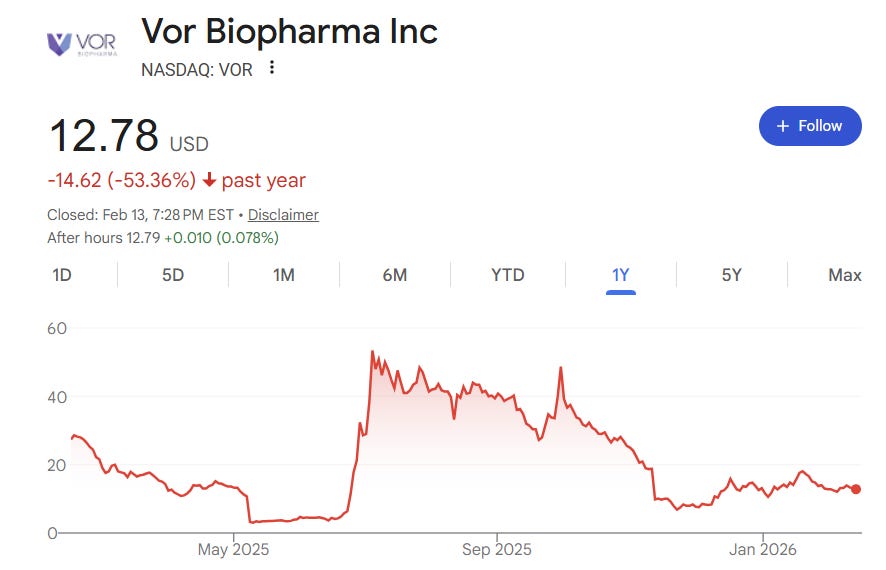
Vor has been a bit of a rollercoaster to say the least. It spiked on the licensing news, but fell when they did another share offering at $10/share in November.
Vor did two more rounds of financing with RA, Forbion, and others, which has lead us to today, where Ra and Forbion both have board seats1, and the firm has around ~$400mm in cash and a market cap of ~$1.15 billion2. Vor intends to use this cash to fund two different phase 3 trials for Telitacicept, one for generalized Myasthenia Gravis, the other for Sjögren’s syndrome.
The set up feels very interesting. We have a company with two blue chip biotech investment firms on the board, and a big slug of cash raised to fund two phase 3 trials in large addressable markets based on promising clinical data. If the trials are successful Telitacicept could have a drug with billions in potential revenues, which would mean huge upside from the current stock price. But what makes this really attractive is that the phase 3 trials are very clinically de-risked because RemeGen has already successfully completed trials in China! That’s not to say there is zero clinical risk, but Vor has a drug that has already completed phase 3 trials and has been on the market in China for years.3
And the market isn’t just these two conditions - Telita is a multi-purpose autoimmune drug. RemeGen has 3 approvals already and a 4th successful phase 3 in China. And there are several other immune conditions Telita may be effective for. But zooming in on the immediate future, the total addressable market of just gMG and Sjogrens alone is very large. Vyvgart, a drug from Argenx, is on pace to do around $5-6 billion in revenues in 2026 per analyst estimates, with the vast majority of that revenue coming from gMG (it is also approved for Chronic Inflammatory Demyelinating Polyneuropathy, with several diseases in trials currently). Sjogren’s has no specific approved drugs currently, so estimates for its size are just that, estimates, but it appears to be around $1-2 billion per analyst estimates.
Indeed it is worth looking a little more at Argenx, the company which owns Vyvgart. Their stock currently trades at over $50 billion, and Vyvgart is their only commercial product currently. This is because analysts expect Vyvgart revenues to continue to ramp in the currently approved diseases, and also for Argenx to receive approval in other immune diseases. Telitacicept and Vyvgart have different mechanisms of action, but ultimately both are applicable across a range of auto immune diseases (with some overlap but also some differences), and most importantly they both overlap in Vyvgart’s biggest current condition, gMG. So conceivably if Telita could outperform Vyvgart, it wouldn’t be insane to think that Vor could achieve a similar valuation. This feels a bit crazy given that is ~45x the current market cap of Vor, but it shows what an upside scenario might look like!4
Returning to earth, lets say there is a conservative ~$5-7 billion in addressable market across these two conditions (the large majority of which is gMG). At a ~33% market share that could be ~$1.6-2.3 billion in potential revenues. And gMG continues to grow quickly, so combined with the strong efficacy data the revenues may be well above the level I laid out above. But lets say $2 billion in revenues as a base case for easy math - at 2x revenues that is $4 billion in potential value, at 2.5x, $5 billion. $5 billion would be ~4.2x from the current valuation! And back in the biotech boom drugs could trade for 4-5x revenues or even higher. It isn’t crazy here to think that this drug could be worth a higher multiple than 2.5x, because it looks to potentially be best in class for both conditions, and there are several other potential conditions it can treat, meaning it has a very large addressable market.5 Again just look at Argenx’s valuation - over 45x higher! On the negative side, Vor does owe royalty fees to RemeGen in the high single digits to mid teens based on sales tiering. 6
And of course, if the trials fail then the stock is likely essentially a zero. The more likely ‘fail’ scenario in my view is probably a black box warning which hamstrings sales, but at least this scenario isn’t a total loss as some patients who don’t respond to other drugs would potentially try Telita7.
As I hinted earlier, Telitacicept has a very strong efficacy profile. Indeed this is actually probably its biggest risk, that the drug is too effective and carries the potential risk of getting a black box warning in the US if any patients in the phase 3 have a severe illness. But as I detailed in a prior footnote, this risk is I think manageable. SAE’s were comparable or lower than placebo overall for the relevant trials.
The efficacy means it is likely very well positioned to be potentially best in class in its two initial target markets.
For gMG, Telita had a massively higher effect vs placebo, however there is a caveat here. In China it is common to have less of a placebo effect, so it is important to also consider the absolute benefit. Luckily, Telita’s absolute benefit is still the best of any drug currently approved or in the pipeline, at -5.74 change in MG-ADL (the primary measure of disease on a 24 point scale, lower is better). Vyvgart, the current leader, is only -3.2. The leading new competitor would be Nipocalimab, a drug from J&J approved in 2025 which has a score of -4.7. Here is a table comparing Telita to all the other gMG drugs. Vyvgart was such a breakout success because it was the first drug available which didn’t carry a black box warning, which significantly expanded the market.
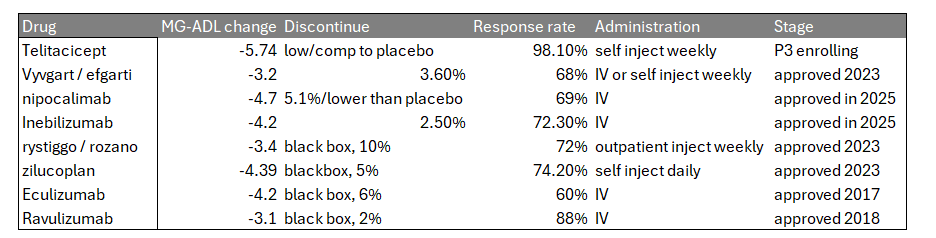
Worth noting that Telita calculates a response rate on a 3 point change, as do several of the black box drugs. Vyvgart is a sustained 2 point, and nipo is just 2 points. The exact Telita discontinue rate was not disclosed but was similar to placebo.
As you can see from the table above, Telita appears to be by far and away best in class. A much larger effect, much higher response rate, and a relatively convenient method of administration, combined with minimal side effects (the biggest was a higher rate of colds).
Sjogrens as I mentioned before has no approved drugs. But there are several competitors in clinical trials, as you can see below.
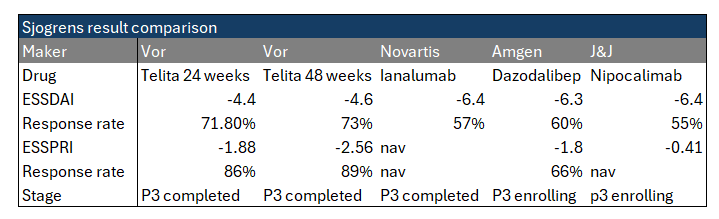
ESSDAI is a clinical measure, and ESSPRI is patient reported symptoms - lower is better for both. The NAV ESSPRI data is because those drugs had no meaningful effect. Discontinue / SAE rates are low for all drugs.
Again I didn’t list here the placebo adjusted scores, in those Telita demolishes the competition. As I mentioned before, there is often a reduced placebo effect in China, so to be conservative I am assuming that occurred here and am instead focusing on the absolute changes.8 But there is some chance the global P3 trials for Telita translate into even higher absolute scores!
Regardless, even assuming the absolute scores don’t change, Telita is arguably best in class based on the above data alone. While the ESSDAI data is a bit worse than competitors, the response rates are much higher, as are the ESSPRI data. If you wanted to overweight ESSDAI I’d still argue Telita is roughly on par with Dazo, and certainly any patient who fails one of the other drugs would likely be put on Telita given the much higher response rate.
So in sum - Telita looks very well positioned in both its initial target markets, and in a base case could generate significant revenues and value if these two trials are successful. And given the significant clinical data out of China, success seems fairly likely (although not assured!).
Telitacicept is a type of drug called a fusion protein. I’ll try not to get too far into the weeds on the science here, but basically the drug works for autoimmune conditions by suppressing B cell activity, the overexpression of which is often responsible for autoimmune diseases. Telita has already completed its phase 3 trials in China, and has been on the market there since 2021. It is approved for 3 conditions in China, Systemic Lupus Erythematosus, Rheumatoid Arthritis, and generalized Myasthenia Gravis.9 It also completed a successful phase 3 in China for Sjögren’s syndrome.
However the FDA generally will not accept accept Chinese clinical trial data, so this is why RemeGen is partnering with Vor to run its international trials.
There is also some history here worth noting for a similar drug which failed, which may also be a reason the stock is so cheap. That drug is called Atacicept, and was being tested in a study for Lupus Nephritis. It suppressed the immune system too much and one of the first patients died from pneumonia, which obviously lead to the trial being cancelled. There are a few big differences here. The first and biggest is that unfortunately the Atacicept trial paired it with another immune suppressant during that trial10. So it isn’t even a read on just Atacicept by itself, as the immune system was hit by a double whammy. But further the RemeGen team specifically made alterations to the drug to reduce its immune suppressive effect & make the drug more ‘stable’ - one of the issues with the prior drug is it may have delivered its payload in a more lumpy manner, causing dangerous spikes in immune suppression. Finally Lupus patients are generally much sicker than gMG or Sjogrens, hence the reason Vor is focused on the latter two first.
All that said, I am not terribly worried about this history given the thousand of patients who have received Telitacicept in China - the only way it could have some horrendous safety profile would be some kind of wide scale fraud and coverup11. Not impossible but seems highly unlikely and I’m trusting the RA & Forbion teams to have confirmed this is not the case.
One thing worth discussing is how this stock trades, which is a bit strangely. The daily volume has been around 500-750k, which is over ~1% of shares outstanding, not bad you would think. But I have found the stock ‘feels’ like it trades like something with a far lower volume/market cap. I’m not a trading expert so I honestly don’t know what’s going on here, but its odd (another possibility frankly is I am just misreading things here!). The blocks available for sale are typically pretty small, so perhaps this is related to it. And to top it all off, if you search for $ vor on twitter, its just tons and tons of bots posting the exact same messages about it.
I asked Gemini about this, and it suggested there may be a bunch of wash trading by bots to try and give an illusion of false liquidity, which sort of matches all the Twitter bot posting. If this is true, and I’m not sure it is, its unclear what their end goal is (pump stock up, or dump their holdings), and I’m not sure how much it matters if you have a long term perspective based on success in the underlying business. But I wanted to make sure people aware of this strangeness!
Another item worth highlighting in a bit more depth is the significant major shareholder selling history. RA sold a bunch of shares in 2025 when the stock was in the upper 20s, and right before the issuance of new shares at ~$10/share in November (which RA bought into, not a great look generally but good for them). I don’t know if this was RA closing out an older investment (they were invested prior to the RemeGen deal), or simply capitalizing on the opportunity to sell the stock at a healthy price, but regardless it put some pressure on the stock and shows RA is clearly willing to sell if the share price gets high enough. Reid Hoffman was also an older investor and sold a bunch of shares around this time, but not all of his holdings. All this is to say - if the stock rallies strongly again we could see some more large sales by either of these two large shareholders, which could hold down the share price some. But I’m not too worried if a large shareholder decided to sell at ~2x+ from the current price, that is a good bit of upside from now.
To bring it all together - we have a significantly de-risked clinical asset with a very strong competitive profile with a large addressable market. The company is being led by new management and has huge ownership by multiple blue chip biotech funds, two of which have seats on the board. And the company has enough cash to complete their two phase 3 trials, which should wrap up in 2028. The set up is almost as clean as you could ask for, and yet the stock trades for far below what the potential pay off might be. The upside appears to be around ~4.2x on the base case, possibly much higher, and while the downside is significant (as is usually the case in bio), the odds seem relatively low. At 80% chance of a 4.2x, 20% of a 0 (and no credence to an upside scenario), the EV is 3.36 - very attractive over a mere 2-3 years.
Both granted in December 2025 after the latest private funding round which was done at ~$10.8/share.
You might see a lower market cap number on Google or Yahoo finance, this is because there are a huge number of outstanding warrants that would further dilute the share base. My calculation assumes they are all exercised, which almost certainly will occur given the nominal strike prices on the vast majority of the warrants. The warrants are mostly to RemeGen and the big pipe investors, and Reid Hoffman still holds some ~$16.75 or so dollar strike warrants from his pre-Telitacicept investment.
The risks here specifically I think are two fold. The first is that Telita is too effective, and that the strong but manageable immune reduction response seen in China might be too much for America’s typically more obese patient population. It seems unlikely to be so bad as to risk no approval, but there is some risk of a potential black box warning if a patient got something severe like meningitis. This risk feels relatively low to me - tens of thousands of patients in China have gotten this drug and there are no reports of significant side effects like this. In the RA trial serious adverse event rates were actually lower than placebo, but in the sicker Lupus population upper respiratory infections were more common on Telita than placebo at 31.7% vs 19%, although SAEs were again actually more common in the placebo. This is likely why Vor did not target Lupus as one of their two first indications to minimize any potential failure risk.
The other is just some kind of fraud or error in the Chinese data. I suspect this is why the market is not valuing Vor very highly, but I don’t think this risk is very high. China does not have incentives as a country to approve bad medicines, and Chinese biotech’s have really been having a lot of success globally recently. A huge portion of big pharma’s acquisition budget is being spent on Chinese drugs. And best of all here we have two very well regarded biotech funds on the board who have invested in a big way - I have to believe if there was large scale fraud or cover up here they would have discovered it. Not to say the risk is zero, but given the huge upside here it feels very manageable.
I frankly also have not gone condition by condition in depth for each drug to truly compare the end addressable market to try and better assess what Vor’s upside case scenario might look like - the current pricing is attractive enough for the base case to be sufficient, with any upside just pure bonus.
To start with, there are the two other conditions Telitacicept is already approved for in China, Rheumatoid Arthritis and Systematic Lupus Erythematosus. Then there are a number of other conditions RemeGen is running trials for in China, notably IgAN, Lupus Nephritis, and Primary Membranous Nephropathy. I am probably under-emphasizing the potential market for this drug, for example take Rheumatoid Arthritis (RA). The RA market globally is enormous and it looks like Telita may be able to deliver similar clinical benefits as other drugs with possibly a better safety profile. SLE is a multi billion dollar market, and Telita compares well to leading drugs there.
Interestingly, when Vor licensed the drug from Telita, it didn’t pay all that much cash, only $45mm up front. Instead the main consideration was equity warrants worth $80mm at the time, or about ~18% of the business as fully diluted today. This is probably one of the main reasons RemeGen picked Vor - a big pharma co would never agree to such a deal.
A black box warning is industry parlance for a very prominent black warning label about potentially life threatening side effects - for Telita, if this occurred, it would probably be for serious infections. Several competitive drugs have such warnings for example. As you can imagine, patients and doctors greatly prefer drugs without such warnings if they are available.
The standard of care is also different and one explanation for the low placebo effect is a relatively lower amount of care provided ex drug. So I believe there is a decent chance Telita’s placebo adjusted score translates into even higher absolute scores in the global trial. In other words China trial’s are call it ‘low’ care + drug (or placebo), and the global trials are ‘high’ care + drug/placebo. If the care makes a difference, then both placebo & drug are boosted. Thus if Telita really is just better, when you stack it with the ‘high’ global care the absolute score values might rise even further.
Specifically Telitacicept was first approved for Systemic Lupus Erythematosus in 2021, Rheumatoid Arthritis in 2024, and gMG in 2025 in China, with the recent successful phase 3 Sjogrens trial completing in 2025.
Apparently they had no choice because the other drug was standard of care so it was viewed as unethical to give someone potentially ‘less’ than standard of care. But unfortunately the combination was too powerful.
Again there is some chance that lower occurrence side effects manifest more commonly in the generally more obese US patient population.