United Parks and Resorts (PRKS), the owner of Seaworld, Busch Gardens and a few smaller resorts, is a very interesting high yield hard asset opportunity right now.
First though, please take a look at my usual disclaimer.1 This post & research was created for & with Valyte Data, the hard asset data business I co-founded. Valyte provides investment data and research on hard asset business with a big focus on REITs. We released this report first to Valyte paying customers, and are now making it freely available as part of our marketing efforts. If you are interested in REIT, real estate, or hard asset data or research, check us out at www.valytedata.com.2 The idea is to move more REIT and hard asset commentary to Valyte, and increase the output quantity, while keeping this substack for more general write ups, commentary, updates and some company deep dives.
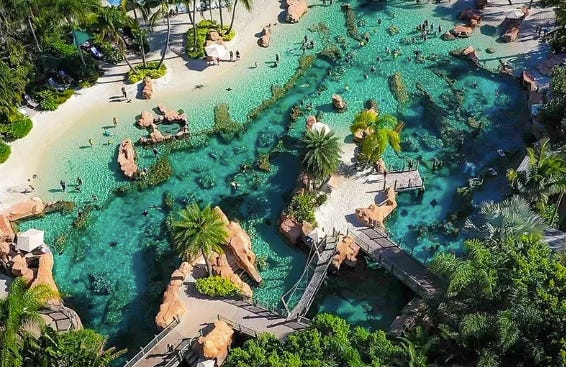
Discovery Cove in Orlando
With the housekeeping out of the way, here is the PRKS set up. At today’s price of ~$46/share the company is trading at a ~8 x EV/ebitda multiple or a ~11.85% implied cap rate using a real estate asset lens3. This alone is pretty attractive for durable hard assets, but what is really interesting here is the ownership situation and the potential for a short squeeze.
Somewhat uniquely, PRKS has a huge ~57% owner in the form of investment group Hill Path Capital4. While PRKS is especially cheap today, theme parks have always traded at fairly low EV/Ebitda multiples perhaps because they are somewhat of a unique, orphaned hard asset class. They have basically all the characteristics of a REIT, but they cannot easily turn into a REIT because the RIDEA structure only allows hotels and healthcare assets - entertainment is left out sadly.
Regardless of the why, Hill Path seems to have found a solution to this problem, and that is simply buying back as much of the company’s stock as possible. This mechanically forces yields higher for the remaining owners (of which Hill is the vast majority obviously).
And at a ~11.85% cap rate, there is a good amount of cash to be funneled into buybacks. The AFFO yield is about ~9.3% or around ~$210mm /year, and management seems fairly intent on funneling almost 100% of that cash (after taxes) into buybacks.5
The market cap right now is about $2 billion. Given that Hill owns over ~2/3s, there is a little over $700mm in remaining stock available to trade, or about ~15.5 million shares. The current short interest on the stock is about 7 million6, or around 45% of the free float. Now as we all know a large portion of ownership is passive these days, so the short interest as a percentage of the actual effective float is much higher - the big 3 indices alone own another 7.6mm shares - this brings us to an effective actual free float of ~7.93mm. Days to cover is 7 days or so based on the recent ~1mm in daily volume.
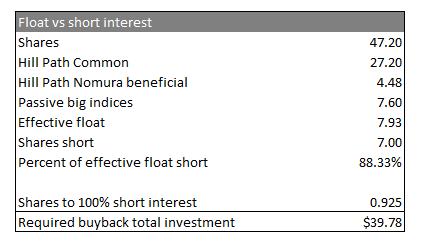

In the top 10 owners there are 5 large hedge funds that own another ~8.9 million shares. I am going to go out on a limb and guess these investors understand the same potential short cover dynamics, and likely are not immediate sellers barring a big price increase. If we include these funds in the ownership structure, the float available to cover shorts is already essentially zero.
This is a bit oversimplified (the indices and hedge funds can sell, and Hill could too!), but the fact is that this set up makes PRKS effectively one of the most shorted stocks in the market relative to its true immediately available float.
You can probably see where I’m going here at this point but I’ll spell it all out anyways. Park has ~$715mm in free float at current prices. Park can spend ~$155mm/year in buybacks7 - in crude terms in 4.5 years there would literally be almost no more float remaining. Obviously that isn’t going to happen8, but it is pretty clear that Hill Path seems to be intent on buying as much of the company for itself as possible at today’s low prices.
All of this together means this situation is something of a potential perfect storm for a short squeeze. You have a company with a tiny free float plowing huge amounts of cash into buybacks. Its a mere $40mm away from passing ~100% effective short interest on the purchasable float - this may well happen before the Q2 earnings date and may already have occurred given the furious rate they have been buying back shares through Q1 earnings. PRKS could literally buy back all the remaining non passive float for ~$340mm, or just over 2 years of cash flow. This would perhaps not coincidentally match up with Hill’s 70% ownership cap laid out in the last share repurchase authorization9.
I don’t know if a short squeeze is going to happen or not, but this situation seems like an absolute powder keg. If Q2 earnings go well that could serve as a catalyst - and while Q1 was soft, pass sales (which drive 40% of visits) were up a whopping 12%+ through early April.
Now obviously a squeeze may never occur! The overall market could tank. Earnings could disappoint. Shorts could close out in an orderly manner before PRKS can buy enough shares to foment a squeeze. Etc etc.
But the beauty of this investment is that a short squeeze is just an upside scenario, a potential catalyst. The stock is cheap! And the continued buybacks will mechanically continue to drive the yield up higher. If the company buys back such that Hill is a 70% owner common owner, you get to nearly a 15% cap rate in 4 years, assuming the stock somehow doesn’t move at all and there is 1.5%/year noi growth. At a minimum though it sure seems like unless ebitda declines significantly from here shorts will have to cover in either an orderly or disorderly fashion. Combining that with the firm’s aggressive buybacks and it presents some favorable supply and demand fundamentals for the stock itself as potential shorts covering would add to buy interest.
Here is the break down on the valuation I am using.
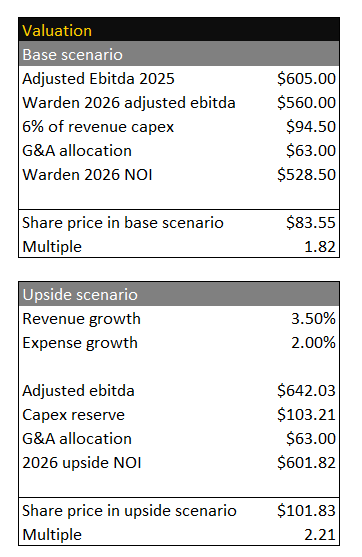
Base case assumes ebitda decline from 2025, upside assumes 3.5% revenue growth and 2% expense growth. PRKS has actually been able to reduce expenses on an ongoing basis since 2015, with expenses flat from 2016 to 2023, however 2025 had their highest opex growth in a long time ex covid at 3.12%.
I am valuing these assets through a commercial property lens, because they are basically just hospitality real estate companies. The only reason they are not REITs is that the RIDEA laws don’t allow it, and a sale/leaseback structure a la casinos would be difficult to make work due to prevailing ebitdar to rent coverage norms being designed for more volatile gaming businesses + theme parks are fairly capex intensive and putting that all onto the operator would be difficult to make work.
But other than the legal structure, its the same idea. They own huge pieces of property that they monetize by daily visitation, with a mix of tickets (a la bookings), and on site spending (a la F&B).
So, to normalize the comparison I calculate an NOI for PRKS, just like a hotel asset. In this case I subtract a 6% of revenues capex reserve, this reflects the capital intensive nature of the business and is what Six Flags charges in JVs or to third party operators10. Then I add back a G&A allowance, as NOI is meant to be a property level income figure. PRKS themselves gives a property level ebitda but it adds back too much G&A in my view, so what I use is 1% of the stabilized company enterprise value. This is a bit on the high end for REITs especially given this is a multi billion dollar business, but I wanted to be conservative.
Then, I use a cap rate to value the assets. In this case I use a 8.5% cap rate - again using hospitality as a benchmark this seems fairly conservative. Hotel assets are trading in the 7-9% cap rate range in the public markets, and a bit lower than that cap rate wise in the private markets. Theme parks have had less significant earnings drawdowns in recessions than hotels, so all else equal would warrant a lower cap rate than hotel assets11. But I am using a higher rate here because the inability to use a REIT structure definitely deserves some higher yield premium, and then the lack of a robust private market means its hard to enforce discipline on the public markets.
It is worth noting that historically these businesses traded around a 9x EV to ebitda for many years pre-covid. That is around a 10.5% cap rate, and in my view is just too cheap relative to entertainment alternatives, and also just in an absolute sense given the asset quality and earnings durability.
And this is something of the beauty of Hill’s strategy - PRKS has arguably been undervalued for awhile, and is more so today, even against these historical benchmarks. Rather than trying to sell the assets to a limited buyer pool, they are using massive buybacks to capitalize on the cheap pricing and drive either share price or yield higher.
I’ll go into a little more detail on what PRKS owns here. The company has a nice slide in their most recent deck showing their major parks.
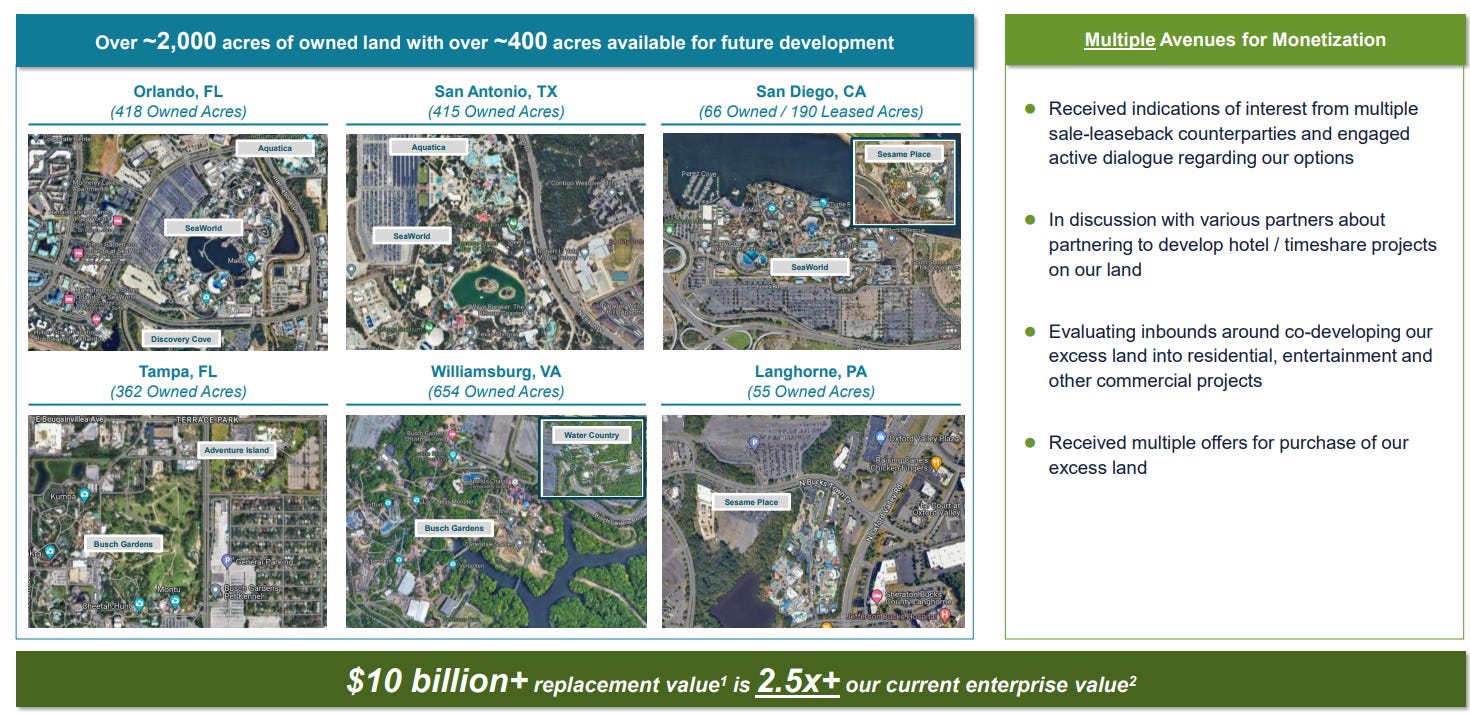
Management estimates replacement cost at over $10 billion - I estimate its more like $7-8B, still a significant increase from the current ~$4.4 B EV.
For some sense of how important each park is, here is a chart with estimated visitors and potential revenues per park. The chart is LLM generated and may not be 100% accurate but is indicative of the approximate importance of each asset.
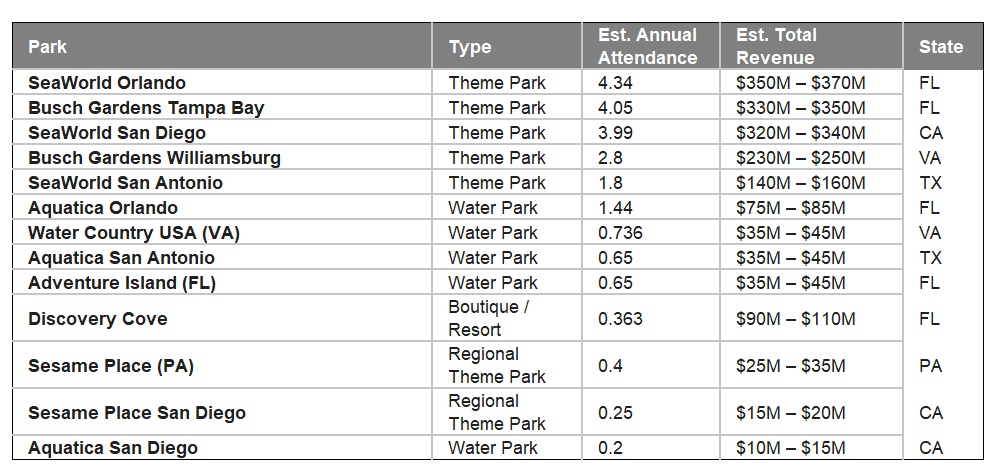
Demographically & weather wise, PRKS’s assets are well located. Orlando is the largest market, followed by Tampa and San Diego, then Virginia (in between Richmond and Norfolk), and finally San Antonio. Except for San Diego, these locations are all benefiting from strong ongoing population growth. The biggest negative here is that the Orlando market has seen significant new supply in the form of Universal’s new Epic Universe, which was a huge new park that opened in May 2025.
The Epic Universe opening almost certainly weighed on Orlando results, but as we are a year later so the remaining impact should hopefully be limited12. Seaworld’s tickets are significantly cheaper, $60 online vs $140 for the new Epic Universe, which has likely helped Seaworld be a bit more insulated from the new supply.
On the weather side, since PRKS’s assets are basically all in warm weather all year states they do not face quite as much weather seasonality risk as Six Flags does or operators located in more northern locations that are only open really in the warm season. This allows PRKS to have a higher margins as they get more utilization out of their fixed asset and labor base, again reducing earnings volatility.
Finally PRKS also has a much younger ride base, as they really moved more into the rollercoaster space in the mid to early 2010s after they reduced emphasis on their Orca shows in the aftermath of the Blackfish documentary controversy. This again is a net positive for PRKS, as these newer, higher quality rides likely require less maintenance capex. It is also worth noting here that PRKS invests a significant amount of capex into their properties above and beyond the 6% reserve that seems to industry minimum - they typically do 12-13% of revenues in total capex. I treat all of this as essentially maintenance in order to maintain quality and competitive standing given other parks also continue to improve their experiences.
So overall, PRKS’s parks sit in between Disney’s full destination high dollar parks, and Six Flag’s more regional drive to parks. PRKS’s sunbelt focus + fewer, higher quality parks allows it to maintain higher operating margins compared to near peer Six Flag’s.
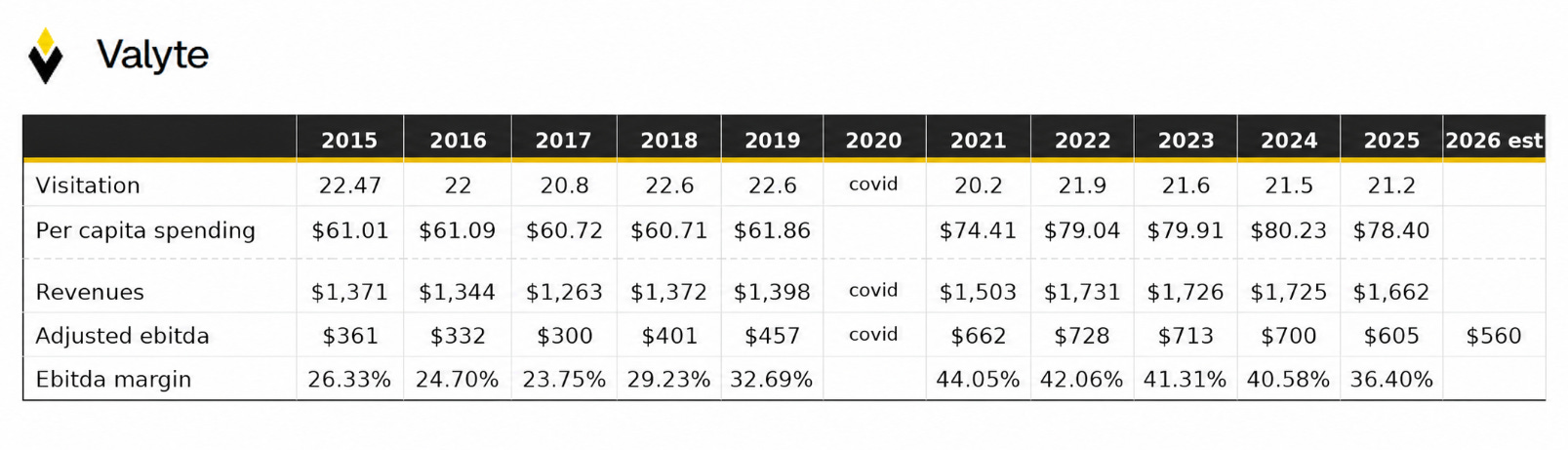
Despite the positives on the property front, operating performance has been soft for PRKS recently as EBITDA declined significantly in 2025. Management blamed lower international tourism and bad weather for the declines - frankly I’m not so sure, although weather is very important for PRKS and any theme park.
The parks are obviously outdoors, and as such when its rainy attendance is going to be slashed. Given the seasonality of the business, where the ~26 Q2 and Q3 weekends drive a very large portion of the business, a relatively small variance in rain out could well cause meaningful revenue swings. What makes me a bit skeptical of this is the consistent performance from 22-24, and then all of a sudden things go south in 2025 right when significant new supply hits the Orlando market.13
For 2026, Q1 was negative, but Q1 is the weakest quarter of the year so its hard to draw too much in the way of conclusions for the full year. Attendance was down ~5.5% but per capita spending was up 2%. Management blamed most of the decline on especially cold winter weather, and it is true that Florida saw a particularly cold January and February this year. However management also blamed much of 2025’s underperformance on bad weather, which again makes me a bit skeptical of how valid this really is.
On the bullish side, pass sales were up a very strong 10% in Q1 and 12% through the end of April, and pass sales holders are ~40% of PRKS’ visitation. The last time management noted pass sales being up 10% was 2018, which had a huge 33% ebitda growth over 2017 driven by ~8.6% overall attendance gains.
Management also said they ‘remained committed’ to FY ebitda growth despite a soft Q1. To be conservative I have assumed that FY 2026 is a moderate ebitda decline from 2025, but it seems fairly reasonable that it is roughly flat or possibly even up. If pass sales are really a meaningful indicator then 2026 results could be up significantly over 2025.
To try and get a read on the overall industry we can try to compare PRKS to Six Flags. However this comparison is made difficult by the fact that Six Flags raised its prices significantly more than PRKS did post Covid (by 50% vs 28%), and saw a huge nearly 40% attendance decline. And unfortunately for Six Flags, ebitda actually declined 10% from 2019 to 2023, before the Cedar Fair merger boosted it. The price increase seems to have been overly aggressive and back fired. Most relevant to today, Six Flags had a ~4.2% attendance decline in 2025, much worse than PRKS’s ~1.2% attendance decline.
The difference in performance may also be attributed to differing value offerings between the parks - Seaworld is arguably a more differentiated offering than a general theme park like Six Flags.
But regardless, the only thing we can really infer from comparing to Six Flags historical performance is that Seaworld is some combination of better run or a more attractive destination to consumers.
Disney is the other big public theme park operator, but they don’t break out their data quite as cleanly as Six / PRKS because its lumped in with things like their cruises. Still from the data disclosed it looks like Disney performed similarly to PRKS, with a moderate attendance decline and large price / earnings increases from 2019 to post covid. However importantly 2025 showed continued strength for Disney with 8% Parks & Experiences ebitda growth, compared to PRKS’s decline.
Overall - for whatever reason it looks like attendance for theme parks was down in 2025, although Disney does not disclose attendance figures and the industry figures are not available yet so we can’t be sure Disney didn’t drive ebitda growth from pricing + non theme park experiences earnings.14
Digging into the short squeeze potential a bit more, I cannot find a situation quite like this in the historic precedents (based on my AI research which admittedly is likely missing some instances!). Most other high short interest stocks are companies with weak businesses and poor cash flow generation. PRKS seems fairly unique in that the underlying business is healthy.
The best recent analogies are probably Kohl’s or Avis.
Starting with Avis as its the most recent comp. Avis similarly has a large ~50% owner in the form of SRS. A hedge fund, Pentwater, accumulated enough shares to push effective short interest over 100%. The revelation of this stake triggered panic in shorts and a squeeze, leading to a short term ~7x spike.
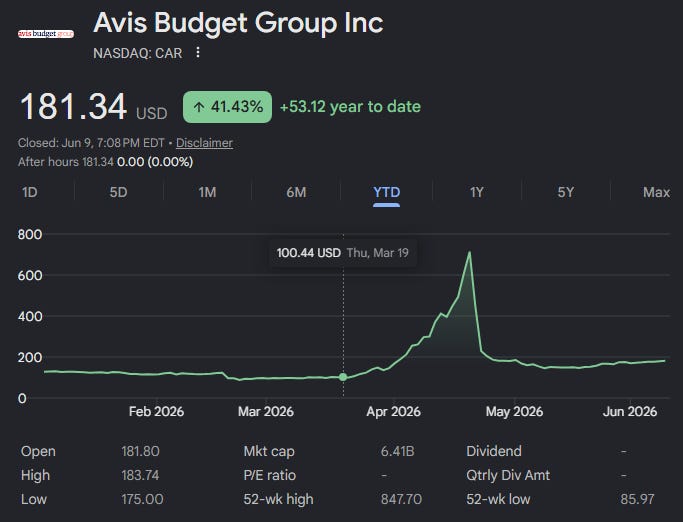
A key thing here is even after the squeeze the price was ~80% higher than the pre-squeeze price. This is common in many recent short squeezes (although definitely not all!).
There are two big differences here though. The first and most notable is that Avis had literally almost 100% of float tied up by its two major owners, before even factoring in passive ownership. The second is Avis is operationally much weaker, it had negative free cash flow in 2025 after accounting for investments in vehicles, and had a gaap loss. PRKS is only going to hit 100% of short interest potentially after factoring in passive owners (assuming no other large investors enter into the stock), however unlike Avis PRKS has significant ongoing buybacks reducing the total overall share count. Overall I’d say Avis was a stronger squeeze candidate, the complete tie up of float is hard to match.
The overall set up may be more similar to what happened with Kohls in 2025, although there are key differences here too.
Kohls had about 49% of its total float held short by mid July last year, and more like 70% after factoring in passive holdings.
The trigger for Kohl’s was a meme type surge in interest fueled by Redditors, which drove a 100% intra day price increase in mid July, and ultimately a ~40% single day jump. However the stock continued to climb, and peaked in the mid 20s in December after relatively less bad earnings, up 2.5x from before the surge, before falling back down to ~$18 today.
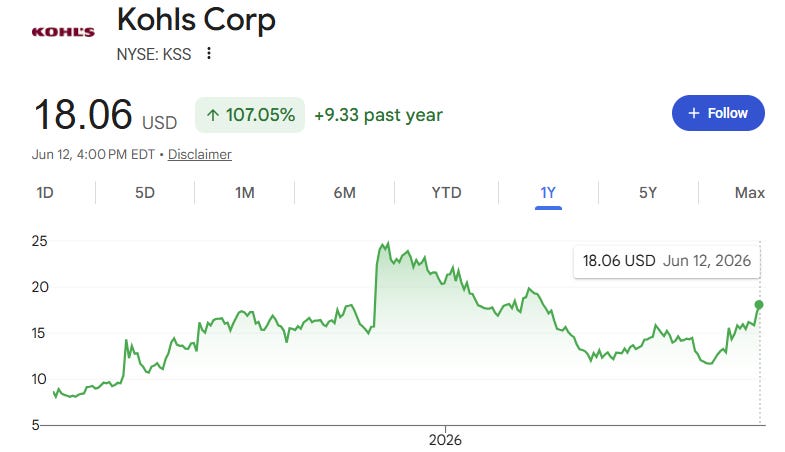
A couple of major differences here. Kohl’s is much more levered, so the total EV swings were actually relatively not that large (although I’m not sure squeezed short sellers nor Redditors ultimately cared much about this). The biggest though is that Kohl’s was and still is struggling operationally. Same store sales declined throughout 2025, and the Q4 ‘strength’ was still negative same store sales. Department stores remain a very challenged sector, and the business has huge amounts of additional effective leverage due to its large number of leased stores. In other words, there remains a pretty real risk of a terminal zero here.
You could argue that PRKS is also struggling, given its significant ebitda declines from a few years ago, but I think this is more an uneven normalization from covid recovery, with revenues being frontloaded while expense inflation being a bit back loaded, combined with new supply pressure in their Orlando market15. These factors shouldn’t be a huge influence going forward, and I don’t think anyone is arguing the theme park business is in terminal decline. And most importantly free cash flow remains strong, and PRKS seems committed to continuing to run its huge, aggressive buyback program, providing fuel that Kohl’s never had available.
So the set up overall seems much better than Kohl’s, although weaker than Avis. What is missing is a spark to ignite the fire.
The investment here is obviously not without risks.
Beyond a mass consumer exodus from theme parks or mismanagement, operating performance declining during a recession is the most obvious downside. And the AI boom is feeling quite frothy although a crash doesn’t seem as imminent if this Hormuz deal really does get done16.
Seaworld/PRKS was not public during the GFC, but Six Flags was public for both the 2000 tech bust and the financial crisis so we can look at its performance during each to give us some indication of how things might go for PRKS in the next downturn.
Surprisingly (to me at least), is that Six Flag’s EBITDA really wasn’t that terribly impacted from the two downturns.
During the 2000 bust, earnings declined slowly from 2000 to 2002, but only went down about 5.55%, which is really not bad at all.
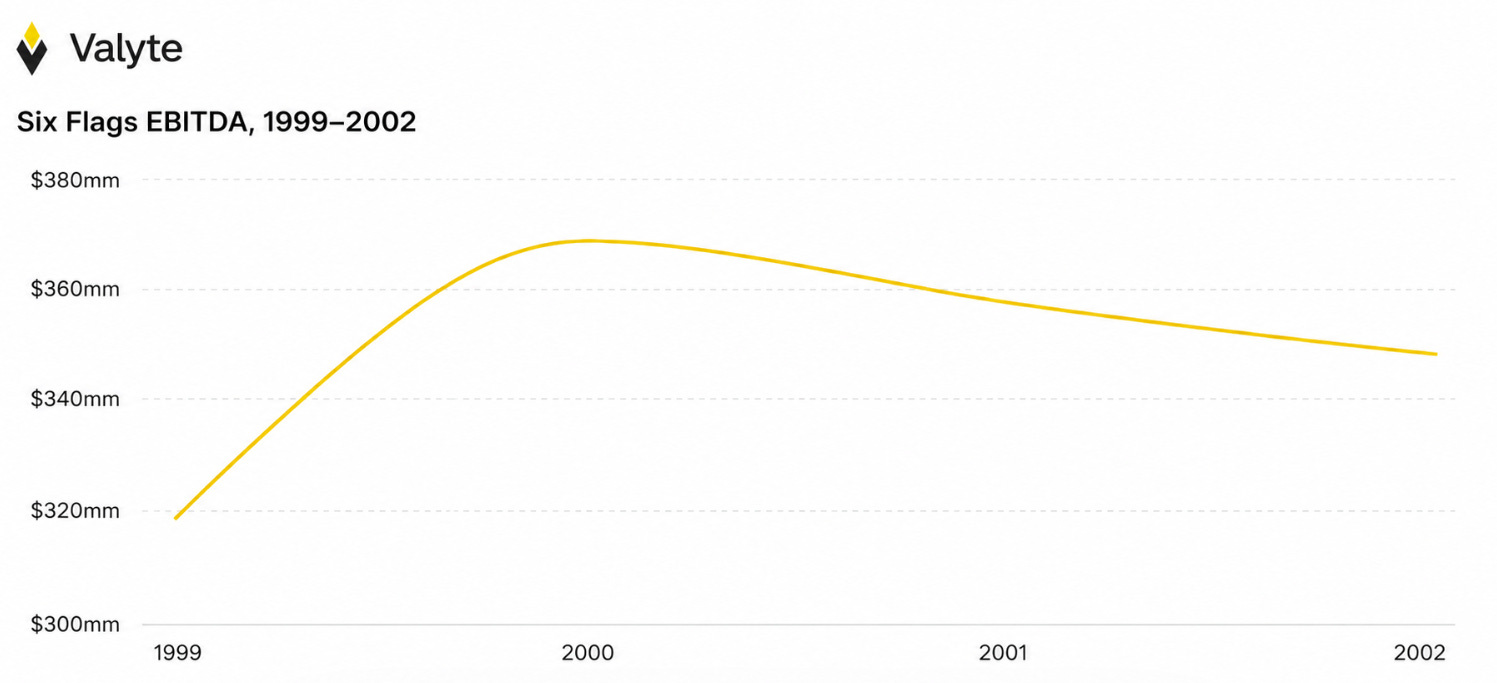
Heck today PRKS’s (and also Six Flags) Ebitda is down much more than 5% from 2022/23 peak earnings, due to a mixture of some covid bullwhip demand unwind + new supply + delayed inflation pressure on the cost side.
During the GFC, pretty amazingly 2008 was actually a banner year driven by strong attendance and revenue growth. Six Flags is highly seasonal and the true crisis didn’t really begin until later in the fall, so arguably the 2008 season was mostly unmarred by the downturn and 2009/2010 are more representative.
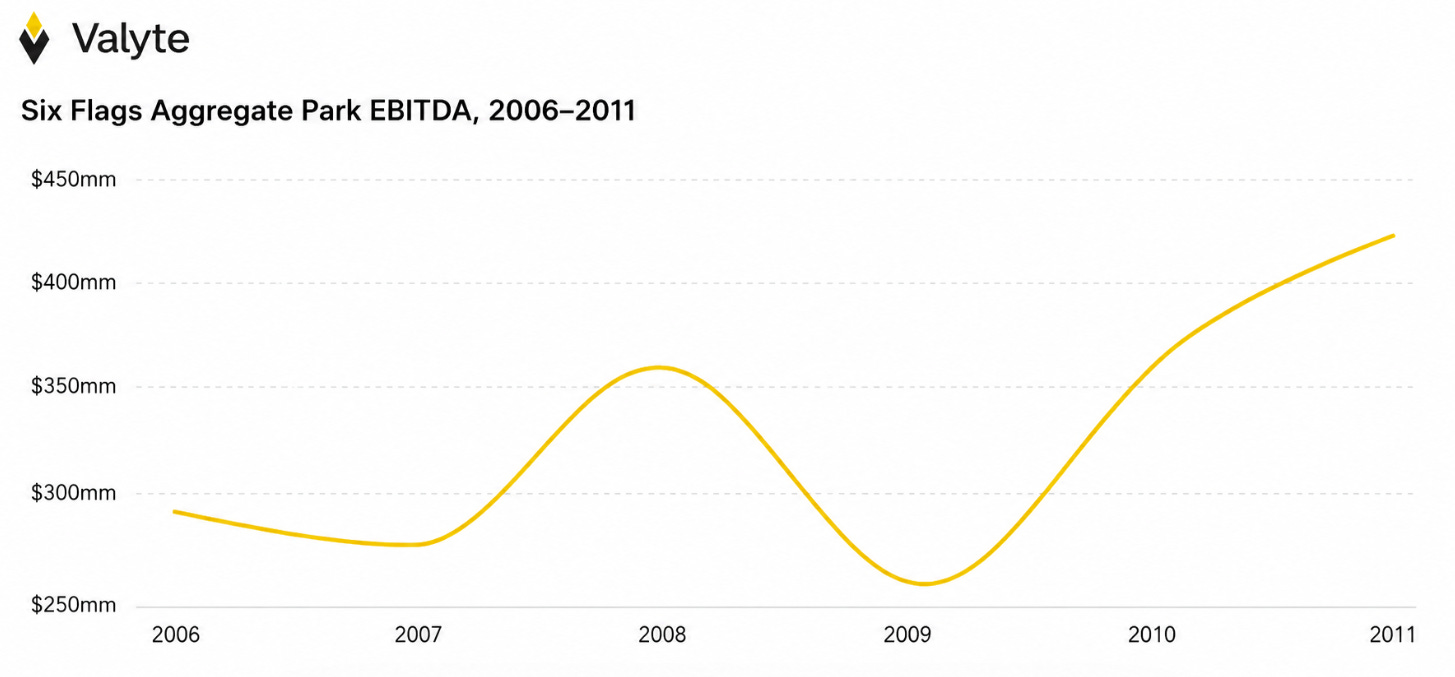
If we take that as being true, then the 2009 decline may be more indicative, at a pretty hefty 26% from the 2008 figures.17 However as you can see results rebounded amazingly quickly the following year, and even grew a good deal in 2011 above 2008 levels. Some of this may been ongoing operational improvements made, but nonetheless the results are actually not bad at all for a proper crisis. It may be that amusement parks actually do relatively well during recessions, especially the more affordable regional drive to parks, because they offer up one of the cheaper vacation experiences out there. Even today Seaworld tickets are ~$60 for what can easily be a full day of entertainment - that is less than the per person bill at many fine dining restaurant today, and pales in comparison to a real vacation for which the travel and hotels alone can easily run over $1,000 even for a basic trip.
That said, PRKS’ Orlando assets and San Diego assets likely do draw a decent chunk of traffic from destination tourism to both those markets, which may make PRKS a bit more susceptible to a downturn than Six Flags. However potentially offsetting this is the fact that Six Flag’s margin is a good bit lower than PRKS, so PRKS would need a larger revenue decline to lead to the same level of EBITDA declines (given the cost base is relatively fixed).
So - overall the EBITDA declines from a downturn seems pretty manageable and even with a 25% decline PRKS would be able to easily service its debt and have extra cash to spare for debt repayment or capex. To put this in CRE terms, its quite a bit better than hotels did during the GFC for comparison.
Another risk is another pandemic with lockdowns - covid was way worse for entertainment than the GFC was (obviously). I won’t spend too much time on this as I think everyone is still pretty fresh on this & understands it would be bad, but the odds of this are pretty low it seems.
The last risk may be most important, since it is specific to PRKS, and that is what might happen to the stock if the company succeeds in buying back a ton more shares without pushing the share price up much. In this scenario you could see Hill Path owning 70-80% of the stock and feeling stuck if the additional buybacks didn’t push the share price up at all. I actually don’t think this would be so bad - obviously it would be disappointing to see the stock not move, but as I mentioned above this would mechanically further drive up the yields on the existing shares. To repeat myself, enough buybacks to get Hill to 70% would bring the yield on cost to close to a 15% cap with only 1.5% noi growth per year. At that point, I suspect Hill would switch over into dividend paying mode, which would generate a very nice yield for existing investors. If they funneled 100% of the free cash flow into dividends, as opposed to buybacks, this could generate a 12%+ dividend yield in a few years. At that point it doesn’t really matter if the share price appreciates.
Or, the least the government can do for the permanent underclass is buy them all theme park season passes.
I feel slightly absurd writing about AI in discussion of a theme park operator, but we are in the heat of the AI boom so I couldn’t help myself. Not to disappoint, but there really isn’t a direct AI angle. I mean sure maybe PRKS can save a little bit of G&A cost with AI, but the impact here, if any, really is indirect. More specifically - if you really believe AI is massively transformative and that all the datacenter capex is going to earn a huge ROI18 and the semiconductors stocks will stay elevated forever, then you are also making a bunch of downstream assumptions on the overall US economy. As the only way the current AI booms works out without a bust is if revenue growth (or cost savings) associated with AI grow massively from here, on the scale of hundreds of billions of dollars a year. And really the only way that happens is if AI generates a huge productivity boost, and creates massive amounts of wealth and consumer surplus.
Which means, basically, a bet on the AI boom continuing is a bet the US economy has many years of elevated economic growth ahead of it. And if that happens, consumer leisure assets like United Parks and Resorts are likely going to do well. So there you have it, we have a new bottleneck trade - the leisure bottleneck! Its the ultimate downstream implication of the AI boom.
In sum, we have a durable consumer hard asset business trading at an attractive yield well below replacement cost. As a bonus we have a near term catalyst in the form of big share buybacks and stretched short coverage, which could potentially even result in a short squeeze. While Q1 was soft, its a small portion of annual revenues and there are signs the rest of the year could be quite strong given the 12% YoY pass sales through April.
And if Q2 earnings do go well and it is revealed that PRKS continued to buy back stock that could potentially be a trigger moment. But even if no squeeze ever happens the buybacks will continue to drive yield higher, generating an attractive investment either way so long as NOI continues to grow.
Risk feels manageable and more generalized to the economy than specific to the company. There is no major secular headwind against amusement parks. I believe the outcome here is asymmetrically skewed to the upside, which is one of the main things I look for in an investment.
As always thanks for reading.
To be even more explicit about this - I own shares in PRKS personally and in some of my investment vehicles. Please assume they may be sold at any time.
We are offering a sign up discount of 25%, use this code FRIENDSOFWARDENCAPITAL
The cap rate calculation is adding back a company level G&A allowance, and then taking a 6% capex reserve. It is to allow for an apples to apples comparison to a CRE investment like hotels. It is not meant to be a sale/leaseback calculation, this is different and will be covered elsewhere.
Hill’s direct ownership is 27.2mm, and they appear to own an additional economic beneficial interest through Nomura of 4.475mm, which does not seem to count toward their 70% common ownership limit which was included in the most recent buyback authorization. It isn’t 100% clear they still own the 4.475mm but I am fairly confident they do - Nomura has this listed on their books as of Q1, and Hill 100% did have the swaps in 2024. In 2025 Nomura revealed their common ownership was much lower as of Q2, but it popped back up again right to the same historic level, so it seems like the dip may have been possibly related to the notional exposure moving to a different prime broker or perhaps a slight gap in it being rolled forward. All of that is to say, I believe 67% is more the correct number to use.
Since PRKS isn’t a REIT, it is worth noting that the AFFO comparison obviously isn’t clean due to PRKS’s inferior tax situation. The additional tax bill would warrant a slightly higher required yield all else equal.
I have also seen data saying 7.5mm shares are short but I will use the lower figure to be conservative here.
They already spent ~$150mm by the Q1 earnings release so far this year!
For one thing, Hill has a 70% cap on ownership through the buybacks per the special authorization the company did in 2025. So to go past 70% would require another vote - thus I treat 70% as my more likely maximum scenario.
A point of clarification - the 70% is on the share’s Hill owns outright, the additional shares held through Nomura are structured for economic interest but not voting power etc, and so don’t seem to count against Hill’s 70% cap. Thus for buyback purposes hill is at ~57% and could max out at 70%.
In fact Six Flags just sold some smaller parks to a newly capitalized operator and this is the capex requirement put into that deal. For comparison hotels are 4% typically, mandated by the franchisor. In both cases actual capex is higher, the requirement is just a fixed set aside to keep up competitiveness and refresh offerings, and is in addition to typical wear and tear capex.
Post reserve capex is also relatively similar, or even lower for theme parks depending on what share of hotel capex you think is accretive & ‘growth’. At ~0% accretive hotel capex approaches 30% of NOI, at 50% its more like 15%, varying by REIT of course.
Management said it didn’t impact attendance for Orlando but would not share spend figures, so I suspect they may have cut prices to stay competitive here, sacrificing price for volume.
To do a little digging on this excuse I had ChatGPT go and look at PRKS earnings transcripts from 2022 onward, and pretty much every single quarter from 2023 to today management blamed bad performance on poor weather or calendar shifts. So it is a little hard to believe this time its actually meaningful.
Universal, the other major theme park group, is owned by Comcast and doesn’t disclose its figures publicly, although some lagging private data is available. So we have no information as to how their parks performed in 2025.
Attendance was apparently up YoY last year for Orlando, but I suspect they may have had to cut price or increase marketing to get the attendance boost. So my money is still on Epic having a negative impact.
I realize I have now jinxed us, my apologies if this is indeed the top.
I would be remiss if I did not note that Six Flags went bankrupt in 2009 - obviously EBITDA wasn’t down that much from 2006/2007, but they were just way too over levered, which combined with the financial crisis lead to a bankruptcy.
I personally do not think said ROI is going to materialize as I have made clear on here… the required revenues and profits are simply too massive. AI will create a lot of economic value, but a whole lot of capital is going to be flushed away in the process, just like pretty much every historic supply side boom.